Best Casinos for Online Craps in the UK: What the Licence Buys You, What the Bonus Costs
 Available in GB
The short version is this: a UK player looking for craps online has one legal doorway, and every claim a marketing page makes about “instant”, “anonymous” or “no questions asked” craps is, at best, an irrelevance standing outside it. The doorway is a Gambling Commission remote casino licence, and behind it sits a set of consumer protections that the bonus headline never mentions — identity checks before the first deposit, GAMSTOP self-exclusion enforced across the whole licensed market, a 10x cap on wagering since 19 December 2025, and an automatic financial vulnerability check once £150 of net deposits has rolled through in 30 days. Anything sold to a UK player that does not come through that doorway has none of those, which is the only thing the comparison below takes as a given before it begins.
What follows closes the reader’s actual question: which of the ten UK-licensed sites listed below is worth opening an account with if craps is the game they came for, what each one costs once the welcome headline is stripped away, and where the absence of a figure matters as much as any number that does sit on the page. The wagering-turnover band that the 10x cap imposes is the spine of the cost section; the licence register is the spine of the choice. Both are checked below.
Data current as of 23 September 2026 and verified against the Gambling Commission’s public register, with Remote Gaming Duty figures cross-checked against HMRC guidance.
Table of Contents
- The Crypto Question That Isn’t Really About Crypto
- Bonus Terms on Craps Tables: What the Headline Leaves Out
- Mobile Craps: Browser, App, or Browser-Only
- The Games Themselves: Evolution Live Craps and What the Paytable Says
- The Ten Sites, Side by Side
- The Licensing and Legal Frame
- The Ten Brands in Detail
- Responsible Gambling Around a Craps Table
- The Calculation in One Line
- What to Read Next
- Frequently Asked Questions
The Crypto Question That Isn’t Really About Crypto
Craps is a table game. The dice do not care how the chips got there. The interesting part of “crypto casino with craps UK” is that any UK-licensed site accepting cryptocurrency still has to verify name, address and date of birth before the first deposit, and that requirement — in force since 7 May 2019 — sits above the payment method. A deposit in Bitcoin or Tether is converted into sterling, ring-fenced in a segregated client account, and the player is still subject to GAMSTOP, the £5 (£2 for 18–24) online slot stake limits, the spin-speed minimum of 2.5 seconds on slots, the auto-play ban, and the reverse-withdrawal ban that took full effect on 31 October 2021. None of those relax because the wallet is non-custodial.

What changes is the friction on the way in. Card deposits run through processors that already pass affordability data; crypto deposits often arrive faster and with less front-end friction. That is not nothing, but it is also not anonymity. The licensed sites in the comparison below all sit on the same Commission licence framework regardless of whether they accept Bitcoin, Tether or a debit card, and the differences between them on payment methods are narrower than the marketing language suggests. The crypto framing is, in practice, a payment-rail question dressed up as a freedom question.
The reader who arrived looking for “no KYC craps” will not find it on this page, because no such thing exists for the UK market. Every licensed site listed below completes KYC before the first deposit. Anyone selling otherwise is either unlicensed, in which case the player’s complaint goes nowhere the Commission can hear, or licensed, in which case the “no KYC” promise is wrong.
Bonus Terms on Craps Tables: What the Headline Leaves Out
A craps bonus that sounds generous on the way in is almost always modest once the wagering requirement is applied to it. Since 19 December 2025, every UK-licensed welcome offer has been capped at a 10x wagering multiplier on the bonus amount — split out as deposit + bonus, bonus only, or free-spin winnings, depending on the structure, but never above 10x. Before that date, 35x was the market norm. The 10x cap is a meaningful improvement, and it makes craps bonuses more usable than they were in the pre-cap era, where a £100 bonus could demand £3,500 of qualifying turnover before the player saw a penny of it.

The structure that matters more than the multiplier is whether craps contributes at all. Most UK welcome packages restrict bonus wagering to slots, keno or scratch cards, where the house edge on a single spin is 2–5%, so the casino can comfortably weather 10x turnover. Craps, by contrast, has a Pass Line house edge of 1.41%, which is what makes it one of the better bets on the casino floor but also what makes it a slow grind for clearing a bonus. A site that lists craps at 100% contribution is the best case; a site that lists it at 10–20% makes a £100 bonus effectively a £1,000-turnover job instead of a £1,000-turnover job at full speed. The terms page settles the question, and the reader should treat it as the actual offer rather than the headline.
The 10x cap also kills mixed-product bonuses, where a sportsbook would bundle a few casino free spins onto a betting offer. Those structures are now banned for UK licensees. What remains is a clean bonus on a clean product, which is more honest even if it makes the welcome page read shorter.
The Cost of Clearing a Bonus on Craps
The page’s own calculation sits here, because the 10x cap is the only number a reader can act on without first seeing the brand’s specific offer. Take a bonus of £100 with a 10x wagering requirement: the player must turn over £1,000 in qualifying bets before the bonus converts to withdrawable cash. At a Pass Line stake of, say, £5 a throw, that is 200 bets. At an Odds bet stake of £10 laid behind the line, a further 100 bets at true odds — but Odds bets at 0% house edge do not contribute to wagering, so only the £1,000 on the line itself counts toward the 10x. The £1,000 at a 1.41% house edge produces an expected loss of around £14 across the clear, before any bet goes the player’s way.
That £14 is the median cost. The distribution is wide: a hot streak at the table can clear the wagering with money left over, and a cold one can eat the bonus and half the deposit. The expected-loss number is what a player with no information should plan around. It is also the answer to “what does this bonus really cost me” — not the headline figure, but the house edge on the turnover the bonus forces.
A Bonus-by-Bonus Read of the Market
The market today splits into three structures. The first is the deposit match: “100% up to £100”, which is a £100 bonus on a £100 deposit at 10x, or £1,000 of qualifying turnover. The second is the free-spin package: 50 free spins on a named slot, with winnings paid as bonus funds at 10x. The third is the cashback or “no wagering” structure, where the bonus is paid in cash with no turnover requirement, just the standard identity and affordability checks.
For craps players specifically, the cashback structure is the closest thing to a fair deal the bonus market produces. The deposit match is workable if craps contributes at 100% to wagering — uncommon, but not unknown — and the free-spin package is functionally useless, since the free spins are tied to slots and the winnings still need to be turned over at the casino’s game weighting.
The reader who treats any welcome offer as a starting bankroll rather than as a discount on house edge will be disappointed. The reader who treats it as a fixed-cost experiment with a £14 median outcome has read the terms correctly.
Mobile Craps: Browser, App, or Browser-Only
The mobile question for craps is narrower than for slots. A slot runs in a portrait phone screen almost as well as it does on a desktop. A craps table is a wide layout with seventeen or so bet positions, dice animations and a chip stack, and the layout does not compress. Every UK-licensed operator in the comparison below offers mobile browser play; not every one offers a dedicated iOS or Android app, and the difference matters less than the marketing suggests it does.
A craps table on a browser on a phone in landscape orientation is functionally complete. The bets are tap targets; the roll happens in the centre of the layout. The dedicated app buys push notifications, biometric login, and — sometimes — a marginally faster load — none of which change the outcome of a Pass Line bet. What the dedicated app does not buy is a different craps game. The same RNG or live-dealer feed runs on both, so the house edge is the same.
The one place an app genuinely matters is live dealer craps. Evolution’s Live Craps runs a full table with a real stickman, four cameras and an interactive tutorial, and that product is bandwidth-heavy. A 4G connection will hold it on a phone browser; a flaky hotel Wi-Fi will not, and a downloaded app with offline caching handles the dropout better. For the player who plans to spend real session time at the table, the app is worth installing; for the player who drops in for a dozen throws during a commute, the browser does the job.
Craps is also one of the games where the live product outperforms the RNG. The dice-throw physics, the stickman’s call, the camera cuts between the come-out and point rolls — these are what carry the game, and they read poorly as a random-number-generator animation. Every site in the comparison that offers live dealer craps does so through Evolution, which is the only studio with a UK-licensed live craps product of any scale.
The Games Themselves: Evolution Live Craps and What the Paytable Says
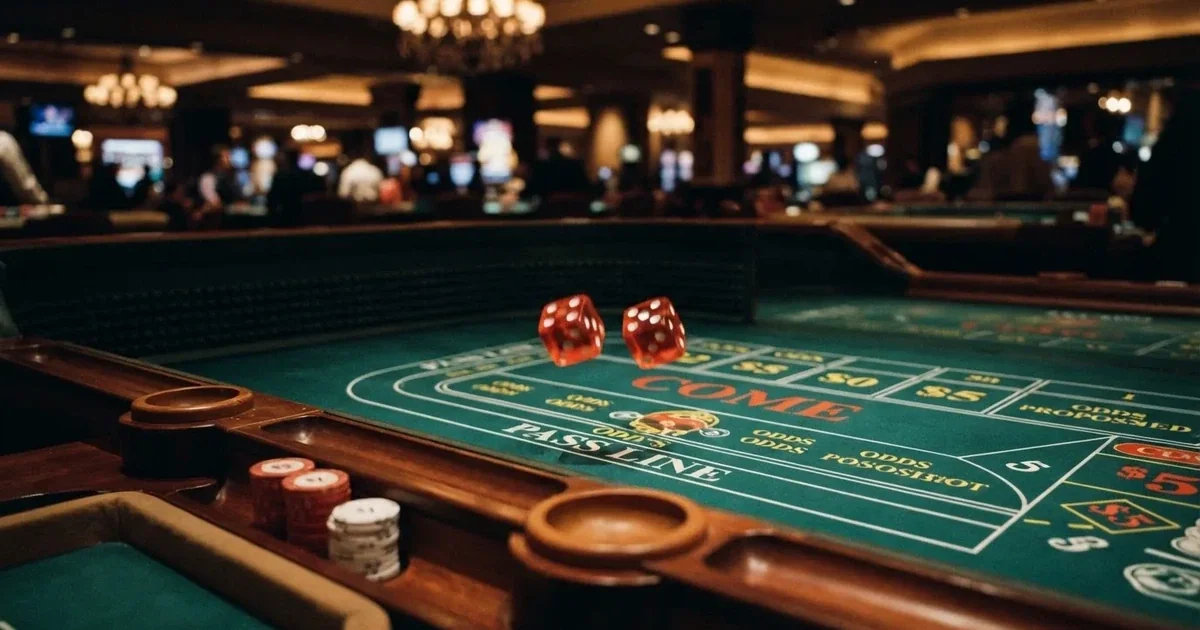
The craps on offer at UK-licensed casinos falls into two camps. The first is Evolution’s Live Craps, which is a real table with a real stickman, set in a speakeasy-themed studio, with a built-in tutorial and an “Easy Mode” that hides the proposition bets for new players. The second is a handful of RNG craps tables from studios like Play’n GO or Pragmatic Play, which deal the dice as an animation and settle bets against a fixed paytable.
Live craps is the better product, and the paytable is the same as any land-based table: Pass Line at 1.41%, Don’t Pass at 1.36%, Come and Don’t Come at the same edges, Odds bets at 0% (true odds). Place bets on 6 and 8 carry a 1.52% house edge; on 5 and 9 it is 4%, on 4 and 10 it is 6.67%. The proposition bets in the centre of the layout — Any Seven at 4:1, Any Craps at 7:1, the Hardways — carry house edges between 9% and 16.7%, and Easy Mode hides them by design. The reader who wants to clear a bonus at minimum cost bets the Pass Line, lays the Odds behind it, and leaves the centre alone.
The structure of the round is worth knowing before the first bet lands. The shooter throws the come-out roll: 7 or 11 wins the Pass Line immediately; 2, 3 or 12 loses it (“craps”). Anything else — 4, 5, 6, 8, 9, 10 — becomes the Point, and the shooter keeps rolling until they hit the Point again (Pass Line wins) or roll a 7 (Pass Line loses). Some bets resolve on the come-out; others ride across multiple throws. Live craps splits each round into those two phases on screen, with the active bets highlighted and the resolved ones swept away. The interface is clearer than most land-based tables, and the Easy Mode hides exactly the bets a beginner should not be touching.
The RNG craps tables settle against a fixed paytable rather than a physical throw, and the house edges are the same as the live game — the software cannot tilt the dice without losing its licence. The difference is texture, not mathematics.
A Note on Game-Like Products That Are Not Craps
A crash game such as Spribe’s Aviator, with more than 42 million reported active users and roughly 350,000 bets per minute across more than 5,000 operators worldwide, sometimes shows up in “dice and crash” categories alongside craps, but it is a different product. A multiplier curve rises from 1.00x and crashes at a random point; the player must cash out before the crash. There is no dice, no shooter, no Point, no Pass Line. It is closer to a stock ticker than to a table game, and the regulatory framework treats it as a slot under the UK game-cycle rules — a 2.5-second minimum spin and the £5/£2 stake cap apply, where they do not apply to craps at all. The reader who arrived looking for craps and found Aviator in the lobby has not found a substitute.
The Ten Sites, Side by Side
The table below lists every operator featured on this page. All ten sit on the Gambling Commission’s public register as either active or white-label domains against a current remote casino operating licence. Subject support — whether the brand carries a craps table of any kind — is not in the register and is not in this comparison; the lobby on the day the reader opens the account is the only place that question settles. What the table does settle is the licence frame, which is the part a comparison can actually verify.
| Brand | Licence holder and GB remote casino licence | Domain status on the register | Subject support |
|---|---|---|---|
| Grosvenor Casinos | Rank Interactive (Gibraltar) Limited (account 57924) — 057924-R-334666-005 | Active | — |
| Betfred | Petfre (Gibraltar) Limited (account 39544) — 039544-R-319290-010 | Active | — |
| 32Red | Platinum Gaming Limited (account 45322) — 045322-R-324275-019 | Active | — |
| BetVictor | BV Gaming Limited (account 39576) — 039576-R-319370-028 | Active | — |
| William Hill | WHG (International) Limited (account 39225) — 039225-R-319373-015 | Active | — |
| Virgin Games | Gamesys Operations Limited (account 38905) — 038905-R-319430-022 | White-label | — |
| Ladbrokes | LC International Limited (account 54743) — 054743-R-330863-014 | Active | — |
| Paddy Power | PPB Games Limited (account 39411) — 039411-R-319335-010 | Active | — |
| Betfair | PPB Games Limited (account 39411) — 039411-R-319335-010 | Active | — |
| Jackpotjoy | Gamesys Operations Limited (account 38905) — 038905-R-319430-022 | Active | — |
The licence number format — six-digit account, “R” for remote, then a four-digit sequence and a suffix — is the standard the register uses. The first six digits always repeat the licence holder’s account number, so two licences sharing an account (Paddy Power and Betfair on 39411; Virgin Games and Jackpotjoy on 38905) signal two brands run by the same operator. The register is searchable online and downloadable as CSV or Excel, and any licence number in this table can be verified against it. A reader who wants to check before depositing should do exactly that: the register is the only source that can confirm a brand is licensed to take UK players today.
What the Spread Looks Like
Ten brands, eight licence accounts. Three of those accounts (PPB Games for Paddy Power and Betfair; Gamesys Operations for Virgin Games and Jackpotjoy) each run two of the brands on the list, which means a reader choosing between, say, Paddy Power and Betfair is choosing between two front doors onto the same operator and the same wallet segregation regime. The white-label entry in the table — Virgin Games — is the only one that trades under another company’s licence rather than holding its own account, and the practical difference is small: white-label sites carry the same player protections as active domains, because the protections attach to the licence, not the brand on the door.
Two of the licence holders are Gibraltar-domiciled (Rank Interactive (Gibraltar) Limited, Petfre (Gibraltar) Limited), which is permitted under the Gambling (Licensing and Advertising) Act 2014 for any operator taking UK customers. Gibraltar is a common jurisdiction for UK-facing remote operators, but it is the Gambling Commission licence — not the Gibraltar one — that authorises play in Great Britain. The reader who sees “Gibraltar” in the small print has not been redirected offshore; the licence they are playing under is still a Commission one.
The Licensing and Legal Frame
A Gambling Commission remote casino operating licence is what separates a UK-licensed craps site from one that has merely put up a webpage. The Commission is sponsored by the Department for Culture, Media and Sport, and the legal frame is the Gambling Act 2005, which covers England, Scotland and Wales. Northern Ireland sits under separate legislation. The 2014 Act closed a longstanding loophole where an operator based overseas could take UK customers on a home-jurisdiction licence; that route has been closed for a decade, and a Curaçao, Malta or Gibraltar licence is not a substitute for a Commission one when it comes to taking deposits from players in Great Britain.
The Commission is also the body that disciplines the licence holders: cease-and-desist notices to unlicensed sites, search-engine delisting referrals, payment and hosting referrals. The Commission has no power to compel ISPs to block illegal sites at network level, which is why unlicensed offshore sites remain reachable from a UK IP address. The penalty for running an unlicensed site is criminal under section 33 of the Gambling Act 2005; the Commission takes the enforcement route, the player pays nothing in fines, and the player also receives no protection if they choose to deposit anyway. No GAMSTOP, no Commission complaints procedure, no approved ADR.
The minimum age is 18 across all Commission-licensed products. The licence conditions require the operator to verify name, address and date of birth before the first deposit or any play — the in-force date for the current form of this rule is 7 May 2019. There is no anonymous play at a licensed site, regardless of payment method. The reader who values privacy above all else is, by definition, looking at a different market.
What the Limits Look Like in Practice
The Commission’s stake limits apply to online slots and to nothing else. The £5 maximum stake per game cycle for players aged 25 and over has been in force since 9 April 2025; the £2 maximum for 18–24s came in on 21 May 2025. Craps, as a table game, is not subject to either figure — there is no Commission-set stake ceiling on a Pass Line bet, which means the player’s own deposit limit and the table minimum are the only constraints. The slot-specific package of consumer-protection rules — the 2.5-second spin minimum, the auto-play ban, the reverse-withdrawal ban that took effect on 31 October 2021, the ban on losses disguised as wins — applies to slots and not to craps.
There is no state-set deposit or loss ceiling. The operator is required to prompt the customer to set a financial limit before the first deposit, and that prompt has been mandatory since 31 October 2025. The customer can set a limit or decline to; the operator cannot waive the prompt. Financial vulnerability checks run at £150 of net deposits in a rolling 30-day window — the figure uses public data only and came into force on 28 February 2025. Wider financial risk assessments have been announced but are not yet binding. Credit cards have been banned for gambling since 14 April 2020, including credit cards routed through e-wallets such as PayPal or Skrill.
The 10x wagering cap, in force since 19 December 2025, applies to every bonus at every licensed site. Mixed-product bonuses — sportsbook-plus-casino bundles, for example — are banned in the same package. What the reader sees on the welcome page is, by design, the cleanest the offer has been since the UK market opened.
Tax
Players pay no tax on gambling winnings in the UK, including craps. Operators pay Remote Gaming Duty, which rose from 21% to 40% from 1 April 2026 — a model the offer pages cannot fully reflect, because the duty is at the operator level and the price the player pays is the house edge. The headline that “winnings are tax-free” is, for the player, true and complete.
The Ten Brands in Detail
Grosvenor Casinos — The Land-Based Pedigree
Grosvenor’s parent, Rank Interactive (Gibraltar) Limited, holds account 57924 and the licence 057924-R-334666-005, with Grosvenor Casinos listed on the register as an active domain. The brand runs around fifty land-based casinos across the UK, and the online product carries that operational footprint: a craps table here has the same physical-casino feel the high-street brand is built on, with Evolution’s live dealer running the table and a lobby that is closer in spirit to a brick-and-mortar floor than to a pure-play online site.
The offer that lands in the welcome package is structured as a deposit match, with the standard 10x cap. The craps coverage depends on the lobby on the day; the live product is what the brand has historically prioritised. For a player who values a land-based operator’s name on the door of the online account, Grosvenor is the closest the list comes to that proposition.
Betfred — The High-Street Familiarity
Betfred’s licence sits with Petfre (Gibraltar) Limited (account 39544, licence 039544-R-319290-010), with Betfred.com active on the register. The brand’s strength is its shop-floor recognition — it has more UK retail outlets than almost any other name on the list — and the online product mirrors that with a broad sportsbook-plus-casino bundle. The current welcome structure is a multi-stage deposit match with the 10x cap in force across each stage.
The craps question is the same as on every other site on the list: the lobby settles it. Evolution’s live craps is the most likely candidate where it is present; the Betfred.com branding does not change the underlying game. A player who values being able to walk into a shop and ask a question about an online query has a fair reason to choose this brand over a digital-only competitor.
32Red — The Long-Running Online Brand
32Red’s licence sits with Platinum Gaming Limited (account 45322, licence 045322-R-324275-019), with 32red active on the register. The brand has been online since 2002 and built a reputation on slots and live dealer products before the live craps category existed in any meaningful form. The welcome offer is a deposit match, sized modestly against the rest of the market, with the 10x cap.
The live craps question is one the lobby on the day answers; 32Red’s product mix has historically skewed toward roulette and blackjack, with craps offered when Evolution’s live feed is integrated into the platform. A player who has held a 32Red account for years and wants to add craps to it has the simplest reason to keep using it.
BetVictor — The Sportsbook-Leaning Brand
BetVictor’s licence sits with BV Gaming Limited (account 39576, licence 039576-R-319370-028), with Betvictor.com active on the register. The brand is primarily a sportsbook, and the casino product is the secondary arm — the welcome structure reflects this, with a sports-tied first-deposit offer and a casino offer that is structured separately. The 10x cap applies to both arms.
The casino lobby has historically been slot-heavy, with live dealer products from Evolution integrated as standard. Where Evolution’s live craps is in the lobby, the brand offers it; where it is not, the brand does not. The craps player picking BetVictor is choosing a sportsbook-plus-casino bundle over a casino-first brand, and that choice has a reason: BetVictor’s pricing on the sports side is competitive in a way the pure-casino brands are not.
William Hill — The Established High-Street Name
William Hill’s licence sits with WHG (International) Limited (account 39225, licence 039225-R-319373-015), with William Hill active on the register. The brand’s UK retail footprint is the largest of any operator on this list, and the online product carries the trust that comes with that scale. The welcome package is a multi-stage deposit match, with the 10x cap on each stage.
For a craps player, the practical question is whether William Hill’s live casino product includes Evolution’s craps feed, which it does on the live lobby on most days. The brand’s value proposition is not craps-specific; it is the reliability of a long-established name.
Virgin Games — The White-Label Front
Virgin Games is the only brand on this list listed as a white-label domain on the register, which means it trades under Gamesys Operations Limited’s licence (account 38905, licence 038905-R-319430-022) rather than holding its own account. Jackpotjoy, the tenth brand on this list, holds the same licence. The player protections are identical because they attach to the licence: same GAMSTOP, same affordability checks, same dispute resolution routes. The white-label status is an operator-side structure, not a player-side reduction.
Virgin Games’ welcome offer is a free-spins package tied to a named slot, with the 10x cap on winnings. For a craps player, that structure is the least useful on this list: free spins cannot be used at the craps table, and the winnings still need to be turned over at the casino’s game weighting, which may exclude craps entirely. The brand is on this list because it is licensed for UK play, not because its offer is the right one for craps.
Ladbrokes — The Same Operator, Different Front Door
Ladbrokes’ licence sits with LC International Limited (account 54743, licence 054743-R-330863-014), with Ladbrokes.com active on the register. LC International also runs Coral and Gala Bingo under the same account. The welcome package is a deposit match with the 10x cap, and the live casino lobby has historically included Evolution’s full table-game suite, craps included where the feed is integrated.
For a craps player, Ladbrokes offers the same live product as every other brand on the list that runs Evolution’s feed, with the brand-name recognition of a long-established UK bookmaker behind it.
Paddy Power — The Same Operator as Betfair
Paddy Power’s licence sits with PPB Games Limited (account 39411, licence 039411-R-319335-010), with Paddy Power active on the register. The same account runs Betfair. The two brands share the same operational structure: same RNG, same live dealer feed, same wallet segregation, same affordability and identity checks.
The welcome offer is a sportsbook-anchored structure with a casino bonus on the side, and the 10x cap applies. A craps player choosing between Paddy Power and Betfair is making a brand-name choice rather than a product choice, because the underlying casino product is the same.
Betfair — The Same Operator as Paddy Power
Betfair’s licence sits with the same PPB Games Limited (account 39411, licence 039411-R-319335-010), with Betfair.com active on the register. The exchange model is Betfair’s distinctive product, but the fixed-odds sportsbook and the casino are the relevant arms for a craps player. The welcome offer is a deposit match with the 10x cap.
The craps coverage on the casino side mirrors Paddy Power’s because the two brands share the same platform. The choice between them is a choice between Betfair’s exchange heritage and Paddy Power’s promotional voice.
Jackpotjoy — The Same Operator as Virgin Games
Jackpotjoy’s licence sits with Gamesys Operations Limited (account 38905, licence 038905-R-319430-022), with Jackpotjoy.com active on the register. The brand runs a bingo-led product, with casino games on the side. The welcome structure is a free-spins package on a named slot, with the 10x cap on winnings — and the same caveat as Virgin Games applies: free spins tied to slots are not usable at a craps table, and the winnings turnover may exclude craps at the casino’s game weighting.
For a craps player, Jackpotjoy is the weakest fit on this list. The brand is on the list because the question is whether the site is licensed for UK play, and the answer is yes. The question of whether the welcome offer suits a craps player is a separate one, and the answer there is no.
Responsible Gambling Around a Craps Table
Craps is one of the lower-house-edge games on a casino floor at 1.41% on the Pass Line, which is the side of the comparison the marketing language lives on. The other side is that craps moves fast: a shooter can resolve twenty throws in a minute, and the centre-of-layout proposition bets at 9–16.7% house edge are exactly the bets a losing streak eats through. The Commission has not imposed slot-style speed limits on table games, because the table game has a natural pacing the slots do not; the player’s own deposit limit and the operator’s reality checks are the regulatory backstop.
GAMSTOP is the national online self-exclusion scheme, and every operator on this list is bound to take part. A player who registers with GAMSTOP for six months, one year or five years cannot open an account at any UK-licensed site for the duration; the period cannot be cancelled early. A self-exclusion also runs against the operator’s own internal list, which excludes the player from marketing, bonus offers and account reactivation for the full period.
Time-out, a shorter cooling-off measure, is also mandatory. So is a reality check at intervals the operator sets, and a financial vulnerability check once £150 of net deposits has rolled through in a rolling 30-day window. The National Gambling Helpline (GamCare) and GambleAware are the two signposted routes for support outside the operator, and the Commission requires the operator to surface both on every responsible-gambling page.
The limits section above is repeated here as a reminder, not because the reader has forgotten it: the financial vulnerability check fires automatically, the deposit limit prompt fires on first deposit, GAMSTOP exclusion is enforced across the whole market. A player who treats any of these as optional is the player the protection is for.
The Calculation in One Line
A £100 bonus at 10x wagering means £1,000 of qualifying turnover. At a £5 Pass Line stake, that is 200 throws; at the 1.41% house edge, the expected loss across the clear is roughly £14, with the actual outcome ranging from a profit on a hot streak to a near-empty wallet on a cold one. The reader who plans around £14 has read the bonus correctly; the reader who plans around the headline has not.
The arithmetic also tells the reader what 10x actually buys. A pre-2025 35x bonus on £100 demanded £3,500 of qualifying turnover and an expected loss of just under £50. The 19 December 2025 cap has cut the median cost of clearing a welcome offer by roughly two-thirds. That is the regulatory gain the page is built around.
What to Read Next
The sections above settle the licence question, the bonus question and the game question. The craps payout mechanics — the structure of the Pass Line, Don’t Pass, Come, Don’t Come and Odds bets, and the proposition bets in the centre — are the same on every UK-licensed site, because they are the same as on a physical table. The 10x cap is the same on every UK-licensed site, because it is the regulatory ceiling. The differences between the ten brands above are real (welcome size, brand familiarity, retail footprint, sportsbook integration) but they are not in the parts of the craps experience the comparison can verify. The reader who has decided craps is the game and a UK-licensed site is the venue should pick a brand on name and welcome offer, then check the lobby for Evolution’s live craps before the first deposit.
Frequently Asked Questions
How do craps payouts work at a licensed UK online casino?
Pass Line pays 1:1 with a 1.41% house edge, Don’t Pass pays 1:1 at 1.36%, and Odds bets behind either line pay at true mathematical odds with a 0% house edge — meaning the casino’s edge on that portion of the stake is zero, although the underlying Pass or Don’t Pass bet still carries its edge. Place bets on 6 or 8 pay 7:6 at 1.52%, on 5 or 9 pay 7:5 at 4%, and on 4 or 10 pay 9:5 at 6.67%.
Is online craps available as a live-dealer game or only as a digital table?
Both. Evolution’s Live Craps is the main live-dealer product, set in a speakeasy-themed studio with a built-in tutorial and an “Easy Mode” that hides the proposition bets for newer players. RNG craps tables from studios like Play’n GO and Pragmatic Play also run at many UK-licensed sites, and they settle against the same paytable as a physical table.
Can craps be played through a casino app on a phone?
Yes, where the operator offers a dedicated iOS or Android app and where the craps product is integrated into the mobile lobby. Browser play in landscape orientation also handles the craps layout on phones and tablets, and the practical difference between the two is the bandwidth handling on live dealer tables rather than the game itself.
Do UK craps tables use the same bet types as a physical casino table?
Yes. The Pass Line, Don’t Pass, Come, Don’t Come, Odds, Place and proposition bets are all available, and the paytables match the standard land-based figures. Easy Mode on Evolution’s Live Craps hides some of the proposition bets but does not change the underlying payouts on the bets that remain visible.
What bonus terms usually apply when a bonus can be used on craps?
Since 19 December 2025, every UK welcome bonus has carried a maximum 10x wagering requirement on the bonus amount, with mixed-product bonuses banned. Craps’ contribution to wagering varies by operator, and a 100% contribution is the best case; sites that list craps at 10–20% effectively multiply the work the player has to do at the table.
Are craps tables offered by crypto-friendly casinos different from standard ones?
No, on the licensed UK market. The craps paytable is the same regardless of payment method, because the game-edge figure sits with the studio (Evolution or the RNG provider), not the cashier. The licensed site’s identity-check, GAMSTOP, affordability-check and bonus-cap obligations apply whether the deposit is in pounds or in cryptocurrency.
Prepared by the welcomeoffersuk editorial staff.