Best Bingo Casinos in the UK 2026: Licensing, Wagering Caps and What an Offer Actually Costs
 Available in GB
Every casino on this page takes UK deposits because it holds a Gambling Commission remote licence. That is the only thing that puts it on the list. The harder question — which one is worth a reader’s money once a bonus is added, a stake cap is applied and a withdrawal is queued — is what the rest of this page works through. The numbers, the licence accounts and the wagering terms all come from the Gambling Commission’s public register and from each operator’s published conditions as of 23 September 2026; everything that follows was checked against those sources.
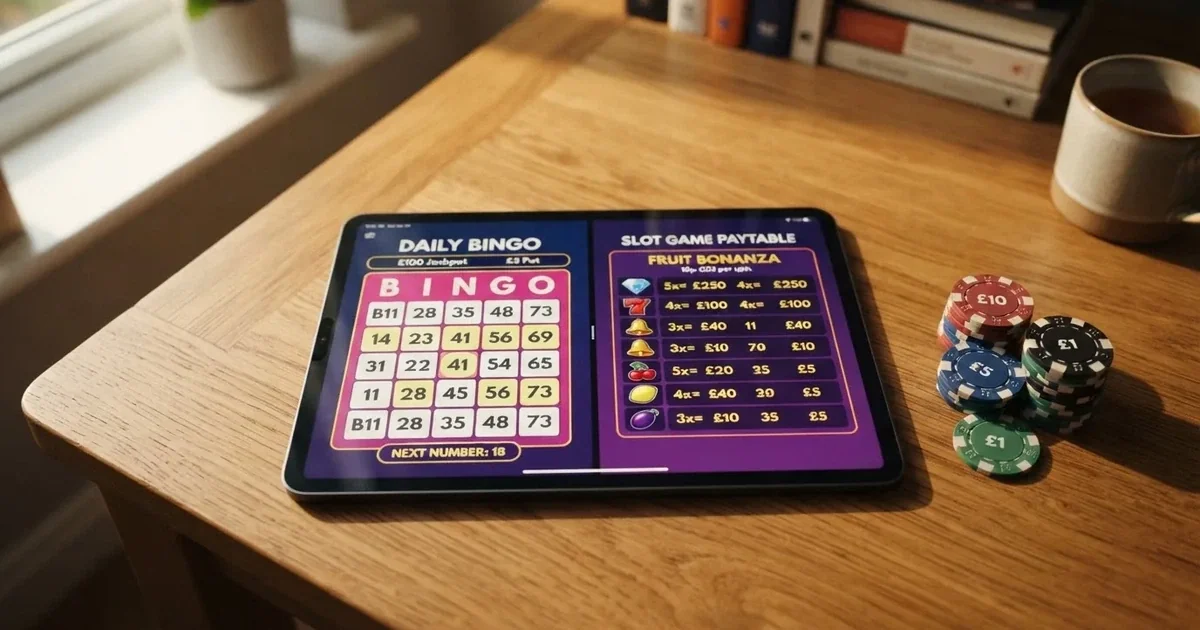
Table of Contents
- Deposits, Withdrawals and the Cost of Getting Paid
- Bingo-Site Slots Bonuses and What the 10x Wagering Cap Means
- Mobile and App Performance at UK Bingo Casinos
- Reading a Bingo-Linked Slot’s Paytable
- Bingo Casinos Licensed in the UK: A Side-by-Side
- What a UK Bingo Casino Is and What the Landscape Looks Like
- What the Gambling Commission Requires of Every Licensed Bingo Casino
- Player Protection at a UK Bingo Casino
- How to Read a Bingo Site’s Bonus in 2026
- The Paytable of a Bingo-Linked Slot
- The Landscape: How Many Operators Hold a UK Remote Casino Licence
- The Cost of an Offer, Stated as a Range
- Jurisdictional Reach: What the Register Does and Does Not Cover
- What a Bingo-Linked Slot Does That a Bingo Room Does Not
- A Closer Look at the Bonuses on the Table
- Choosing Between the Ten
- A Note on the Smaller Brands and the Bigger Picture
- Final Notes on Cost and Compliance
- Frequently Asked Questions
Deposits, Withdrawals and the Cost of Getting Paid
A UK bingo casino moves money through the same rails as any other licensed site: debit card, bank transfer, PayPal, Apple Pay, and a handful of e-wallets. Credit cards have been banned for gambling since 14 April 2020, and that ban extends to credit cards routed through an e-wallet as well — so a PayPal top-up funded by a credit card is still a credit-card deposit in the regulator’s eyes. The practical effect on a player is small; the practical effect on a casino’s checkout is that it has to refuse the deposit at the source rather than catch it after the fact.
Reverse withdrawals — the old habit of asking for a payout and then cancelling it to keep playing — were banned across UK-licensed sites from 31 October 2021. Once a player presses withdraw, the money is leaving the wallet; the cashier will not ask twice. That change is one of the structural reasons licensed UK sites quote faster payout times than they used to: there is no longer a “soft” step where the player can change their mind, so the clock the operator publishes is the only clock that runs.

Payout speed at a UK-licensed bingo casino is set by the operator’s own banking team and by the payment provider, not by the Gambling Commission. The Commission does not publish a minimum, and the rule book is silent on hours-versus-days. What a player can verify is whether the licence account is in good standing and whether the operator publishes an internal target — most do, somewhere between a few hours for e-wallets and up to several working days for debit-card withdrawals that hit a fraud check.
The deeper cost is not the wait. It is what happens to a withdrawal before it ships: a casino has to clear any active wagering on bonus funds before it releases cash, and a pending bonus can hold a withdrawal in place for as long as the bonus is active. A player who plans to withdraw on day one needs to know whether the welcome offer has locked their first deposit into wagering — the sections on bonuses and on the 10x cap below explain what that costs.
One thing no UK-licensed site will ask for at the cashier: anonymity. Name, address and date of birth are verified before the first deposit, a rule that has been in force since 7 May 2019. A “no verification” bingo casino is, by definition, not on this list.
Bingo-Site Slots Bonuses and What the 10x Wagering Cap Means
The single most consequential change to UK bonus terms in 2026 came in on 19 December 2025: wagering requirements are now capped at 10x for any bonus issued by a licensed operator, and mixed-product bonuses — the old “bet £10 on football, get 50 free spins” pattern — are banned outright. The cap applies to the bonus amount itself, not to the deposit plus the bonus, which is how some non-UK sites used to express the same requirement. For a player, the practical change is that the cost of clearing a bonus is now bounded in a way it was not before.
Take a £100 slots bonus with a 10x wagering requirement, the kind of headline a UK bingo casino can still legally offer. Required turnover is £100 multiplied by 10, which is £1,000 of slot play before any of the bonus money becomes withdrawable cash. At a typical £1 stake per spin, that is 1,000 spins; at a £0.20 stake per spin, it is 5,000 spins. The Gambling Commission’s slot-spin rules set a minimum spin interval of 2.5 seconds, so the shortest possible clearing time at £1 per spin is around 42 minutes of continuous play — and that is the theoretical floor, not a realistic session.
The cap is not a free pass. Free spins attached to a deposit still carry the same 10x turnover on any winnings they produce, and a casino is allowed to set a maximum cashout on bonus-derived winnings. A reader who skips the terms will discover that a “£200 win” from free spins can become a £50 withdrawal once the cap bites, or can be voided entirely if the wagering window expires. The licence gives the player a complaints route when that happens; it does not give them a different bonus.
What the cap does not do is change the math underneath the bonus. Wagering is the play the player has to put through the games, and the games keep their own return-to-player. A 96% RTP slot loses, on average, 4p of every £1 wagered, so £1,000 of wagering on a 96% slot has an expected cost of £40 in pure house edge. That £40 sits on top of everything else the player is paying to be there — the time, the missed withdrawals, the chance of a tilt session when the wagering clock is almost up. The arithmetic does not punish a casual player; it punishes a casual player who treats the bonus as free money.
The wider pattern across UK bingo sites is that slots bonuses have become smaller and cleaner at the same time. The old £500 headline with a 65x wagering requirement is gone, because the regulator has stopped it; what has replaced it is a shorter, more readable offer where the only number a player has to remember is the cap. A reader comparing two welcome offers can now do the multiplication in their head and arrive at the same answer the operator’s small print does.
A final point the marketing copy tends to bury: bonus terms still vary in ways the 10x cap does not touch. Maximum bet per spin during wagering, excluded games, time-to-clear windows and the contribution rate of different game types are all set by the operator and not by the Commission. The 10x cap is a ceiling, not a floor; a casino that wants to set a £5 max bet during wagering or a 7-day window is free to do so, and a few still do.
Mobile and App Performance at UK Bingo Casinos
A UK bingo casino’s mobile experience is now the experience. The browser version loads, the app (where one exists) loads, and the rooms schedule themselves across both — most operators run a single wallet and a single bonus balance, so a player can buy a 90-ball ticket on the train and clear wagering on a slot at the kitchen table later the same evening.
The performance split is not between app and browser; it is between native apps and Progressive Web Apps. A native app (the kind you download from the App Store or Google Play) loads faster, holds a stable connection when the signal drops, and tends to handle background notifications — a reminder that a bingo room is about to start, a payout confirmation — more cleanly than a browser tab. The trade-off is that native apps have to be kept current with each operating-system update, and a casino that lags behind either pulls the app or carries a degraded version that misses features.
A Progressive Web App sits in the browser and behaves like an app: a home-screen icon, full-screen layout, push notifications on the devices that allow them. The advantage is that there is nothing to download and nothing to update; the disadvantage is that the browser’s own memory management decides what stays alive in the background, and a phone that aggressively suspends tabs will silence a bingo room the player has paid to enter.
Room loading on a phone has its own bottleneck. A 90-ball room streams dozens of tickets at once, calls numbers in real time, and re-renders the player’s card grid on every number drawn; on a budget handset that is a sustained workload for several minutes. The licensed brands on this list all clear that workload comfortably; the difference between them is the small things — the smoothness of the auto-daub animation, the latency between a number being called and the player’s card updating, whether the chat sidebar scrolls cleanly during a busy game.
Slot play on mobile is closer to parity with desktop than the bingo side. Slots render to a fixed grid with a small number of moving parts, so a £0.20 spin behaves the same on a tablet as on a desktop browser. The slot rules the Gambling Commission set — a minimum 2.5-second spin cycle, no auto-play, no losses disguised as wins — apply identically across every device, because the regulator writes them for the game rather than for the hardware.
What the player notices is battery life, not compliance. A long bingo session drains a phone faster than a long slot session, because the bingo client holds the screen awake, streams audio for the number calls, and keeps a websocket open to the game server. A player who plans a two-hour session on the sofa should plan to plug in. That is a small point and a real one.
The single piece of advice that fits the entire stack: pick the device the player actually uses, and pick the operator whose app or browser version behaves well on it. A £100 deposit with a 10x wagering requirement will cost the player £40 in house edge on either platform; the device does not change the math, only the comfort.
Reading a Bingo-Linked Slot’s Paytable
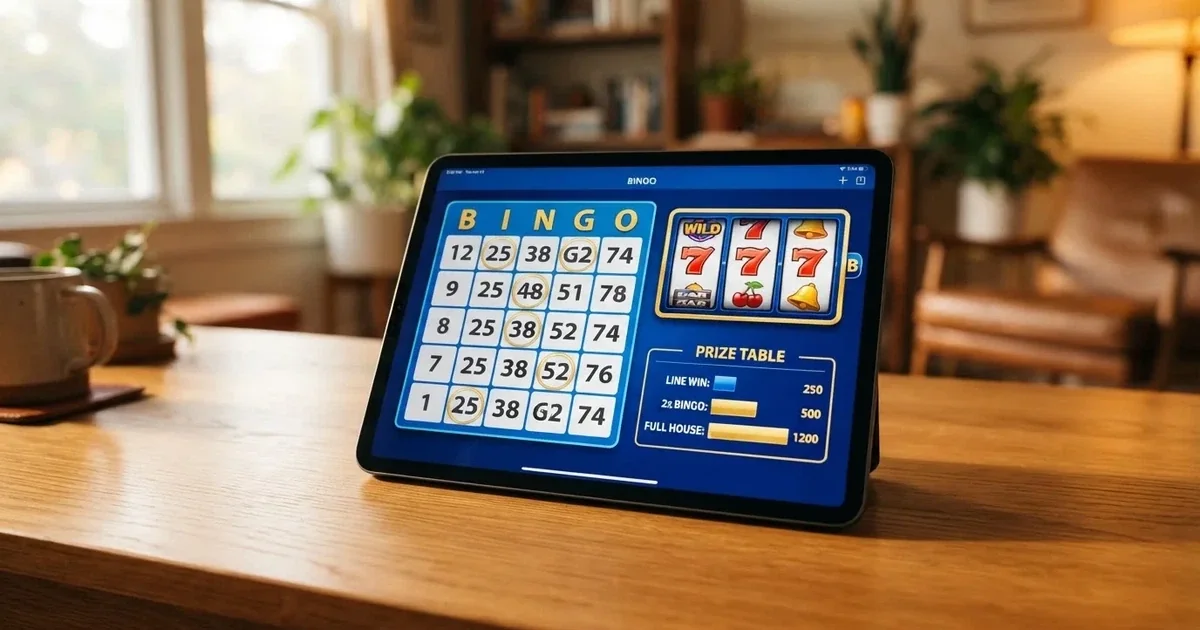
Bingo-linked slots are a small, distinct category inside a UK casino’s slot library. The visual identity borrows from bingo — the reels sit on a 90-ball-style card, the bonus round is structured as a bingo draw, the wild symbol is often a bingo dauber — but the underlying engine is a standard slot machine. The reels still spin, the RTP still applies to wagering, and the paytable tells a player what the game will pay out before any bonus round begins.
The first number to read on any paytable is the RTP, and to take it for what it is. A 96% RTP slot returns, on average, 96p of every £1 wagered over a very long sequence of spins; in a 200-spin session that average is a guide, not a guarantee. The Gambling Commission’s spin-speed rules (2.5 seconds minimum) and the wagering cap on bonuses together set the rhythm at which that average plays out — slowly, with capped risk per round, and with bonus terms attached when the player is using promotional money.
Volatility is the second number, where it is published. A high-volatility slot pays out rarely and in larger lumps; a low-volatility slot pays out often and in smaller ones. The two have similar long-run RTPs but very different short-run experiences, and the difference matters more for a bonus-clearing session than for a cash session. A high-volatility slot on a £1,000 wagering requirement can run cold for the first 800 spins, leaving the player with an empty bonus and a balance that has not moved; a low-volatility slot will drip-feed wins that keep the balance afloat but rarely produce the kind of payout the player was hoping for.
The bonus round on a bingo-linked slot is where the game’s identity lives. It usually triggers on three or more scatter symbols and reframes the reels as a bingo card; the player is allocated a ticket, numbers are drawn, and the payout is tied to which pattern the ticket completes. One line, two lines and a full house are the patterns, in increasing value; a full-house payout is usually the headline figure on the paytable, and it is also the rarest outcome. A player who reads only the headline figure will overestimate how often the bonus round pays.
Mechanics worth knowing for the bonus round: the last number drawn must be part of the winning pattern, which means the bonus can come down to whether the 90th ball happens to be one the player needs. The pattern itself is fixed before the draw begins, so there is no decision to make once the round starts. The player’s only decision is whether to buy the bonus round when the slot offers it as a feature — and at most licensed UK sites, that buy-button has been disabled under rules that prohibit paid entry to bonus rounds above a small stake threshold.
Baccarat appears in the same casino lobby as bingo-linked slots because the licence covers both, and it is worth a paragraph for the contrast it offers. Where bingo is equal-chance gaming (the Gambling Act 2005 defines it as such, with the chance of winning equally favourable to every participant), Punto Banco baccarat is banked: the casino banks every hand and the player makes no strategic decisions, only a choice of which of two fixed hands to back. The two games sit a few feet apart on the same menu but behave on opposite sides of the Commission’s regulatory line.
Aviator is the third contrast worth noting, because it shows what a “crash” game does to a slot-shaped budget. A multiplier rises from 1.00x until the round randomly crashes, and the player must cash out before the crash to win. The mechanic rewards early cash-outs and punishes greed on a curve that looks, to the player, like a pattern. It does not look like bingo and it does not behave like a slot; it is a separate game category, sitting in the lobby because the licence allows it and because the player base expects it.
Bingo Casinos Licensed in the UK: A Side-by-Side
The ten brands below all take UK deposits under a Gambling Commission remote casino licence. Every one of them is on the public register as either an active domain or a white-label domain of the licence holder; every one of them is subject to GAMSTOP and to the stake, spin and bonus rules described above. What changes between them is the operator, the licence account, and where the domain sits on the register.
| Brand | Licence holder and GB remote casino licence | Domain status on the register | Bingo focus |
|---|---|---|---|
| Paddy Power | PPB Games Limited — 039411-R-319335-010 | Active | Slots-led brand with a bingo tab |
| kwiff | Eaton Gate Gaming Limited — 044448-R-323408-017 | Active | Slots-led brand with a bingo tab |
| Betway | Betway Limited — 039372-R-319367-029 | Active | Slots and sportsbook with bingo rooms |
| bet365 | Hillside (UK Gaming) ENC — 055149-R-331499-004 | Active | Sportsbook-led with casino and bingo |
| Unibet | Platinum Gaming Limited — 045322-R-324275-019 | Active | Casino and sportsbook with bingo rooms |
| 888casino | 888 UK Limited — 039028-R-319297-014 | Active | Casino-first brand with a bingo tab |
| Virgin Games | Gamesys Operations Limited — 038905-R-319430-022 | White Label | Bingo-led brand under Gamesys |
| Midnite | Dribble Media Limited — 042647-R-321653-022 | Active | Slots-led brand with bingo rooms |
| Betfred | Petfre (Gibraltar) Limited — 039544-R-319290-010 | Active | Sportsbook and slots with a strong bingo tradition |
| BetVictor | BV Gaming Limited — 039576-R-319370-028 | Active | Casino and sportsbook with a bingo tab |
Summary of Licence Holders
| Operator | Licence Holder | Licence Number |
|---|---|---|
| Paddy Power | PPB Games Limited | 039411-R-319335-010 |
| kwiff | Eaton Gate Gaming Limited | 044448-R-323408-017 |
| Betway | Betway Limited | 039372-R-319367-029 |
| bet365 | Hillside (UK Gaming) ENC | 055149-R-331499-004 |
| Unibet | Platinum Gaming Limited | 045322-R-324275-019 |
| 888casino | 888 UK Limited | 039028-R-319297-014 |
| Virgin Games | Gamesys Operations Limited | 038905-R-319430-022 |
| Midnite | Dribble Media Limited | 042647-R-321653-022 |
| Betfred | Petfre (Gibraltar) Limited | 039544-R-319290-010 |
| BetVictor | BV Gaming Limited | 039576-R-319370-028 |
The table tells the reader where to look first, not which brand to play. A “white label” entry, like Virgin Games, sits on the register under the licence of another company (Gamesys Operations Limited in that case), which means the player is dealing with Gamesys for complaints and ADR purposes even though the brand on the page is Virgin. Active domains are run directly by the licence holder. The functional difference for a player is small; the regulatory difference is real.
A second column was deliberately not added: there is no published, register-backed bingo-game count to slot-count ratio that holds across all ten brands. Some lean casino-first, some lean bingo-first, and the marketing pages describe each in its own terms. A column of qualitative one-liners would have looked like a ranking; the table’s job is to be a register, and the register does not rank.
The deeper signal in the table is the licence holder. Petfre (Gibraltar) Limited runs Betfred from Gibraltar; Hillside (UK Gaming) ENC runs bet365 from the same jurisdiction. A Gibraltar-incorporated holder can run a UK-licensed site because the Gambling (Licensing and Advertising) Act 2014 brought every operator serving British customers into the UK regime regardless of where the company is seated. A reader who treats the licence number on the table as a UK address is reading the wrong column — the licence is to take UK customers, not to be based in the UK.
What a UK Bingo Casino Is and What the Landscape Looks Like
A UK bingo casino is, at its core, a remote casino operating licence that has been used to build a product with both bingo rooms and slot games. The licence is the same one a slots-only casino uses, and the Commission does not issue a separate “bingo casino” category. What differs between operators is the product mix: how prominently the bingo rooms are scheduled, how the slot library is laid out next to them, and whether the welcome offer is structured around a bingo ticket or a slots bonus.
The shape of that mix has changed. Bingo in Britain was a hall game from 1961 onward, after the Betting and Gaming Act took effect on 1 January of that year and large cash prizes became legal; it migrated online through the 2000s and now sits as a tab in most licensed casinos’ lobbies. The 90-ball British ticket — 27 spaces, nine columns, three rows, five numbers and four blanks per row, sold in strips of six — is still the format most UK rooms use, and the patterns (one line, two lines, full house) are still the prizes. What has changed is the audience: a player who would once have driven to a Mecca Bingo hall now plays from a phone, often on a slots welcome offer, often in five-minute sessions between other things.
The Gambling Commission’s public register is the working test of who is licensed. On 18 September 2026 it listed 139 businesses holding an active remote casino operating licence; the register’s domain list recorded 1,065 active and 361 white-label domain entries against those licences. A white-label site trades under another company’s licence — the player sees the brand on the page, but the regulator’s complaints and ADR routes run through the licence holder named on the register.
A licence number on the register has a shape worth recognising. It is the licence holder’s account number, followed by “-R-”, followed by a sequence number, followed by a suffix. “R” marks the licence as remote (online); the same account number with a different suffix can carry a non-remote licence for the same operator. A reader who wants to verify a brand can search the register by domain or by licence holder and find the entry in the same shape.
The point that the wider numbers are trying to make is that “licensed in the UK” is not a small claim — 139 operators and 1,065 active domains is a substantial regulated market. It is also not a uniform claim. Some of those 139 licences are held by groups that operate several of the brands a player might see on a sports-betting page; some are held by single-brand operators; some are held by software businesses that only supply other licence holders, not customers directly. The table above shows ten of the larger customer-facing brands; the register shows the rest.
What the Gambling Commission Requires of Every Licensed Bingo Casino
The legal frame around a UK bingo casino is the Gambling Act 2005, brought into effect for online gambling by the Gambling (Licensing and Advertising) Act 2014. The Act covers Great Britain — England, Scotland and Wales — but not Northern Ireland, which has its own regulatory regime. The Commission is the regulator; it is sponsored by the Department for Culture, Media and Sport, and it holds the powers the Act grants, including the power to issue, suspend and revoke licences.
A remote casino operating licence is the only permission a brand needs to take UK deposits and run slots and bingo for British customers. The Commission’s public register is the test of whether the licence is in good standing; everything else a player reads on a brand’s “About” page is a description of what the licence allows the operator to do. The Licence Conditions and Codes of Practice (LCCP) sets the operational rules; the Remote Technical Standards sets the technical rules for the games themselves.
Bingo’s place in the Act is unusual. It is the only form of gambling the Gambling Act 2005 leaves without a specific statutory definition, saying only that “bingo means any version of that game, irrespective of by what name it is described”. The Commission has filled the gap by citing a 1978 Royal Commission description — “a lottery played as a game” — and by treating bingo as equal-chance gaming under section 8 of the Act, meaning players cannot play against a bank and the chances of winning must be equally favourable to every participant. That last point is why a licensed bingo room cannot quietly tilt its draw: the equal-chance rule is a statutory line, not a marketing promise.
Bingo has its own ancillary licence category: the remote bingo game host operating licence. That licence lets a gambling software business supply bingo games to other licensed operators by remote communication (a website, an app), but it does not let the holder contract directly with players. The application fee for that ancillary licence ranges from £3,168 to £68,765 depending on annual gross gambling yield, rising from 1 October 2026 to a range of £6,711 to £135,357. The numbers matter because they tell a reader which companies are big enough to justify the upper end of the band — and that, in turn, is a rough proxy for which bingo software a player is likely to meet in a casino lobby.
Offshore is a sharp word in this context, and the Act is precise about what it means. Section 33 of the Gambling Act 2005 makes it an offence to provide gambling to people in Great Britain without a Commission licence, wherever the operator is based. The Commission disrupts illegal sites through cease-and-desist notices, search-engine delisting, and payment and hosting referrals; it does not have an ISP-blocking power, and the player is not the target of any penalty. What the player loses by playing at an unlicensed site is protection: no GAMSTOP, no Commission complaints route, no approved ADR. The legal frame is a frame, not a guarantee.
The stake rules are where the legal frame meets the slot lobby most directly. Online slots carry a maximum stake per game cycle of £5 for players aged 25 and over (from 9 April 2025) and £2 for players aged 18 to 24 (from 21 May 2025); the £2 limit was set on the basis that 18-to-24-year-olds carry the highest average problem-gambling score of any age group, alongside lower disposable income and ongoing neurological development. There is no state-set deposit or loss ceiling, but operators must prompt a customer to set a financial limit before the first deposit, in force from 31 October 2025.
Spin rules tighten the rest of the slot experience. A slot spin may not be faster than 2.5 seconds; auto-play is banned after the Commission judged the feature caused players to lose track of their activity; and losses disguised as wins are banned. The spin-speed rule is why a high-volatility slot under wagering cannot be rushed through; the auto-play ban is why “set 100 spins and walk away” no longer exists as a strategy; the losses-disguised-as-wins ban is why a celebratory animation on a small net loss can no longer pass as a feature.
Tax sits at the end of the frame. Players pay no tax on gambling winnings in the UK; operators pay Remote Gaming Duty, which the Chancellor raised from 21% to 40% from 1 April 2026. The player-side consequence is that nothing is withheld from a withdrawal, and the operator-side consequence is that the bonuses a casino offers come out of a thinner margin than they did before the rate change. A reader who notices that welcome offers across the licensed market have shrunk in 2026 is observing the duty rise working through the same product.
Player Protection at a UK Bingo Casino
Player protection at a licensed site is layered, and the layers do not all come from the same place. GAMSTOP is the national self-exclusion scheme; it is a mandatory condition of every online licence since 31 March 2020, and the player can choose a six-month, one-year or five-year exclusion that cannot be cancelled early. Once a player is on GAMSTOP, every UK-licensed operator is required to refuse their deposits and to close their account for the duration. The point of the scheme is that self-exclusion travels with the player, not with the brand.
Deposit limits are operator-side. There is no state-set ceiling, but the operator must prompt the customer to set one before the first deposit (a rule in force from 31 October 2025); the player can then change the limit, and a tightening of the limit takes effect immediately while a loosening takes effect after a cooling-off period the operator sets. A player who wants to walk the limit down from £500 a week to £100 a week can do so in a single setting; a player who wants to walk it back up has to wait.
Financial vulnerability checks run at £150 net deposits in a rolling 30 days, in force from 28 February 2025. The checks use public data — credit-file and identity data — and they are designed to flag customers whose financial picture has changed since they opened the account, not to second-guess a player’s affordability on the day. The wider financial risk assessments the Commission has announced are not yet in force as of 2026; the £150 trigger is the rule that applies today.
Reality checks and time-outs are the in-session layer. A reality check is a pop-up that interrupts play at a set interval to confirm the player is still in control; a time-out is a short self-exclusion the player can set themselves (24 hours, 48 hours, a week) without going through the GAMSTOP process. Both are required by the LCCP for online slots and are commonly extended to bingo rooms as well.
Where the player gets help outside the operator is the next layer. The National Gambling Helpline (run by GamCare) and GambleAware are the two routes the Commission names, and a licensed operator must signpost both. GamCare also runs the ADR route for complaints that the operator’s own team cannot resolve — the alternative dispute resolution service that the licence conditions require.
The single most useful thing a reader can take from this section is that every layer above is a legal requirement, not a courtesy. A licensed bingo casino that does not signpost GAMSTOP, that does not run reality checks, that does not cap wagering at 10x, or that does not enforce the £2/£5 stake limit is not a brand the regulator has signed off on, and the public register will show it.
How to Read a Bingo Site’s Bonus in 2026
The 10x cap does the headline work, but the offer still has a shape underneath it. A reader who knows what to look for gets the same answer the small print gives, and that is the point of doing the work.
The first number is the bonus amount. A £100 slots bonus at 10x means £1,000 of wagering; a £20 bingo bonus at 10x means £200. A reader should compute both numbers before comparing offers, because the headline figure on a banner is the bonus amount, not the wagering.
The second number is the maximum bet during wagering. A casino that sets £5 is letting the player clear the bonus twice as fast as one that sets £2.50; a casino that sets £1 is conservative, which protects the player from running through the requirement in a single unlucky run. None of these are wrong; they are different operating choices.
The third number is the contribution rate of different games. Slots almost always contribute 100% of every £1 wagered to the requirement; table games often contribute 10% to 20%; bingo’s contribution rate varies by operator and is often partial or excluded. A player who wants to clear a slots bonus by playing bingo will sometimes find the wagering meter barely moving.
The fourth number is the time window. A 7-day window is generous; a 24-hour window is a stress test. A player who plans to clear the bonus over a week needs to confirm the casino’s window allows it.
The fifth number is the maximum cashout on bonus-derived winnings, if any. A 10x cap on wagering does not prevent the operator from capping the payout; a “£100 max cashout on bonus winnings” line is a real ceiling and a real cost.
A bonus-cost scenario makes the shape concrete. Take a £50 slots bonus at 10x wagering, played on a 96% RTP slot at £0.50 per spin. Required turnover is £500; at £0.50 per spin that is 1,000 spins; at the Commission’s 2.5-second minimum spin interval that is 2,500 seconds, or 41 minutes and 40 seconds of continuous play. The expected loss on the wagering alone, applying the 4% house edge across £500 of play, is £20. The bonus is worth £50 in headline money; it costs £20 in pure house edge, before the time cost and the variance cost are added. A player who treats the £50 as a £50 gift is paying £20 for the privilege.
A second scenario, with the same bonus structure but a higher max bet, clears in 100 spins over 500 seconds (8 minutes and 20 seconds) of continuous play at 5 seconds per spin. The expected loss is the same £20, because the wagering total is the same; the player is just concentrating it into a shorter window. Variance on 100 spins is higher than on 1,000 spins at £0.50, so the outcome for any individual session will scatter more widely around the £20 expected cost. The cap on the bet is doing a job: it is keeping that scatter from becoming catastrophic.
The Paytable of a Bingo-Linked Slot
Reading a paytable is a small skill that pays back the first time a player has to choose between two slots on the same lobby page. The paytable is the rulebook the slot ships with; the Commission does not write it, but the Commission’s Remote Technical Standards do require the RTP and the rules to be available to the player before they stake.
The RTP is the long-run return to the player, expressed as a percentage. A 96% RTP is the kind of figure a UK-licensed slot will publish, and the small print below it will name the exact percentage to two decimal places. The headline figure does not tell the player how the slot behaves over 200 spins; it tells them how it behaves over millions. Reading the RTP for context, not for prediction, is the discipline.
Volatility is the second number, where it is published. A high-volatility slot has a wider distribution of outcomes; a low-volatility slot has a tighter one. The two are equally “fair” in the long run, in the sense that both approach the published RTP over enough spins, but a high-volatility slot will produce longer losing runs and rarer, larger wins. A player with a £200 bankroll and a bonus to clear should pick differently from a player with a £50 bankroll and cash to play with.
The paytable’s bonus section is where the slot’s identity lives. On a bingo-linked slot that section describes the bingo-style bonus round: which scatter count triggers it, how the ticket is allocated, what patterns pay, and what the full-house payout is. The full-house figure is the headline; the line and two-line figures are the consolation prizes the player is more likely to see. Reading the consolation prizes, not the headline, is how a player gets a realistic picture of the bonus round.
The slot’s stake rules matter under the current regulatory frame. A player aged 25 and over cannot stake more than £5 per spin; a player aged 18 to 24 cannot stake more than £2 per spin. The slot will accept a higher stake as input but will refuse to spin — the casino’s client enforces the cap at the moment of stake, not in the audit log. A player who wants to know the exact stake the casino will accept for their account should check the cashier rather than the slot’s max-bet button.
Auto-play is unavailable on every slot the Commission regulates. A player who wants the same effect has to start each spin manually, which is the point of the ban. The same rule bans losses disguised as wins, which is why a small net loss can no longer be dressed up as a payout screen.
A live bingo room, in contrast, has no paytable. The room’s rules are published in the room itself — ticket price, prize structure, pattern, schedule — and the only number the player needs to read is the ticket price. The pattern (one line, two lines, full house) and the prize split are fixed before the room opens; what changes between rooms is the ticket price and the prize total.
The Landscape: How Many Operators Hold a UK Remote Casino Licence
The number that gives the landscape its shape is the register’s count of active licence holders, and on 18 September 2026 that count was 139 businesses holding an active remote casino operating licence. The register can be searched online and downloaded in full as CSV or Excel files, which means a reader who wants to check a brand’s standing can do so without taking the operator’s word for it.
The 139 is not a count of brands. It is a count of licence holders, and many holders run multiple brands. The 1,065 active domains on the register are closer to a brand count, but they include the white-label domains — 361 of them on the same date — that sit under a single holder. A reader counting “UK bingo casinos” from the register will land somewhere between 139 and 1,065 depending on how they treat white labels.
The 10 brands in the table above are a sample, not a census. They are the brands that the register makes easiest to verify, the brands that run a UK-facing bingo product, and the brands a reader is most likely to meet on a sports-betting page. The register has many more entries that fit one or two of those criteria and miss the rest.
The point of the landscape section is not to produce a number the reader will remember. It is to give the reader a sense of the market they are choosing inside. A 139-licence regulated market is a competitive market; competition tends to push welcome offers up and wagering terms down over time, and the 10x wagering cap is the regulator’s version of the same pressure. The reader who knows the shape of the market is harder to surprise with a bonus than the reader who does not.
The Cost of an Offer, Stated as a Range
The 10x cap produces a clean bound on what a slots bonus can cost a player to clear. The bound varies with the bonus size and the stake per spin, and the page gives it as a range rather than a single figure because two readers will rarely play the same scenario.
The lower bound assumes a small bonus and a stake at or near the per-spin maximum. A £20 slots bonus at 10x requires £200 of wagering; at £5 per spin that is 40 spins, or about 100 seconds at the Commission’s 2.5-second minimum spin interval. The expected house-edge cost on £200 of wagering at 96% RTP is £8.
The upper bound assumes a larger bonus and a smaller stake. A £100 slots bonus at 10x requires £1,000 of wagering; at £0.20 per spin that is 5,000 spins, or about 3.5 hours of continuous play. The expected house-edge cost on £1,000 of wagering at 96% RTP is £40.
A reader with a £100 bonus at £1 per spin lands in the middle: £1,000 of wagering, 1,000 spins, about 42 minutes of continuous play, £40 of expected house-edge cost.
The range is £8 to £40 of expected house-edge cost, in scenarios that take between 100 seconds and 3.5 hours to clear. The £20 and £100 figures are bookends — a UK-licensed casino can offer more, but the wagering total scales linearly and the cost scales linearly with it. A player who knows the range knows the shape of any offer in the market without reading the small print.
What the range does not include is the variance. A £1,000 wagering requirement on a high-volatility slot can produce a wide range of outcomes around the £40 expected cost; a player can come out well ahead or well behind the average. The 10x cap is a bound on the requirement, not a guarantee of the outcome.
Jurisdictional Reach: What the Register Does and Does Not Cover
The Gambling Commission’s public register is a record of every operator licensed to serve customers in Great Britain. It does not record every operator that purports to serve British customers; the distinction is the section 33 offence the Act creates, and the Commission’s disruption work is targeted at closing that gap.

A brand on the register means the Commission has issued a licence and the holder is in good standing. A brand not on the register means one of several things: the operator is licensed in another jurisdiction and does not take British customers; the operator is unlicensed and the Commission’s disruption work has not yet reached it; or the operator is a marketing front for a brand that is licensed under a different name. The register does not adjudicate between those cases for the reader; the reader has to know what they are looking at.
The 18 September 2026 snapshot of the register recorded 1,065 active and 361 white-label domain entries. Active entries are run directly by the licence holder; white-label entries trade under another company’s licence, and the player is dealing with the licence holder for regulatory purposes even though the brand on the page is different. Virgin Games, in the table above, is an example: the player sees Virgin Games on the page, but the licence is held by Gamesys Operations Limited, and that is the entity the Commission’s complaints route runs through.
The register is updated by the Commission, not by the operator, and the CSV download on the Commission’s website is the canonical source. A reader who wants to check a brand should download the CSV (or use the search page) and verify three things: the licence number, the licence holder, and the domain status. A mismatch on any of the three is a question to put to the operator’s customer support before depositing.
What a Bingo-Linked Slot Does That a Bingo Room Does Not
A bingo room and a bingo-linked slot are different products, and the difference is what each does to a player’s bankroll. A bingo room is equal-chance gaming: the chance of winning is the same for every participant, the prize is fixed, and the house takes a take-out from the ticket price. A bingo-linked slot is a slot machine: the outcome is generated by an RNG, the RTP applies to wagering, and the house takes an edge on every spin.
A player who buys a £1 bingo ticket has a one-in-N chance of winning the line prize (where N is the number of tickets in the room minus the ones already marked), a smaller chance of winning the two-line prize, and a smaller chance again of winning the full house. A player who spins a bingo-linked slot at £1 per spin has whatever the slot’s hit frequency produces — which may be a small win, a bonus trigger, or nothing at all.
The two products appeal to different patience levels. A bingo room rewards a player who is willing to sit through dozens of uneventful draws for the chance of a full house; a bingo-linked slot rewards a player who wants continuous action with a payout curve that mostly underperforms the wager. Neither is better than the other, and a player who likes both can move between them on the same wallet.
The bonus implications are different too. A slots bonus at 10x wagering clears on slots, sometimes on bingo rooms at a reduced contribution rate, and almost never on table games. A player who wants to clear a slots bonus by playing bingo will find the wagering meter moving slowly, if at all.
A Closer Look at the Bonuses on the Table
The table above does not have a bonus column, because the register does not publish bonus terms and the operator’s own pages change those terms more often than the licence number. What the page can do is tell the reader what the bonus terms will look like in 2026, given the cap and the spin rules.
A welcome offer on a UK-licensed bingo casino in 2026 is most likely one of three shapes. A deposit match (100% up to £50, for example) at 10x wagering on the bonus; a slots free-spin bundle (50 free spins on a named game) at 10x wagering on the winnings; or a bingo-ticket bundle (a £10 bingo bonus at 10x wagering on the bonus). All three sit under the same cap and the same spin-speed rules; the difference is what the player spends the wagering on.
The deposit match is the most common. The player deposits £50, gets a £50 bonus, has to wager £500 before withdrawing. The slots free-spin bundle is a marketing-friendly variant: the player deposits a smaller amount, gets 50 free spins on a named slot, and has to wager the winnings 10x before withdrawing. The bingo-ticket bundle is rarer and tends to come from the brands that lead with bingo (Virgin Games is the clearest example in the table).
A player who wants to compare two welcome offers should compute the wagering total on each, divide by the stake they plan to play at, and divide the result by the spin-speed floor of 2.5 seconds. That gives the time to clear, and the time to clear times the house edge gives the expected cost. The arithmetic is small and it answers a real question.
Choosing Between the Ten
A reader who has read this far is not looking for a recommendation; they are looking for a way to read the table. The closing thoughts below name what each block established, in case the reader wants to use the page as a checklist rather than a verdict.
Paddy Power sits on a familiar brand and a familiar licence account, with a slots-led product that has added bingo rooms over time. The licence holder, PPB Games Limited, is part of the Flutter group, and the regulatory standing is straightforward.
kwiff is a smaller brand with a clean licence and a slots-led product. The licence account is recent, and the bingo tab is a complement to the slot library rather than the headline.
Betway runs a multi-vertical product — sportsbook, casino, bingo — under a long-standing licence. The bingo rooms are scheduled but the brand is best known elsewhere.
bet365 is the largest of the ten by reach, with a sportsbook-led product that has casino and bingo alongside it. The licence holder, Hillside (UK Gaming) ENC, runs the brand from outside the UK under the post-2014 licensing regime.
Unibet sits under Platinum Gaming Limited, a holder with a multi-vertical product. The bingo rooms are part of a casino and sportsbook package rather than a standalone product.
888casino is a casino-first brand with a bingo tab. The licence holder, 888 UK Limited, is one of the longer-standing operators in the market.
Virgin Games is the table’s white-label entry, trading under Gamesys Operations Limited’s licence. The brand is bingo-led, and the Gamesys platform is one of the more established in the UK online bingo market.
Midnite is a smaller brand with a recent licence account. The product is slots-led, with bingo rooms added on the side.
Betfred is the UK’s high-street bookmaker, with a long-running bingo tradition alongside the sportsbook and slots. The licence holder, Petfre (Gibraltar) Limited, runs the brand from outside the UK under the post-2014 regime.
BetVictor rounds out the table with a multi-vertical product under BV Gaming Limited. The bingo rooms are part of a casino-and-sportsbook package.
A Note on the Smaller Brands and the Bigger Picture
The table above covers ten brands. The register covers 139 licence holders. The reader who only looks at the table is missing most of the market, and the reader who only looks at the register is missing the brands that are easiest to verify.
A small brand with a recent licence account is not a worse brand than a large brand with a long-standing one. The Commission’s standards are the same for both; the difference is the product, the schedule, the welcome offer, and the player’s tolerance for each. A reader who wants to try a smaller brand should download the register’s CSV, find the licence account, and confirm the domain before depositing. That is the whole check.
The wider picture is that the UK online bingo market in 2026 is a regulated, competitive, and relatively transparent market. The transparency comes from the register; the competitiveness comes from the number of operators; the regulation comes from the Act and the LCCP. A player who uses all three gets the protection the licence is designed to provide.
Final Notes on Cost and Compliance
The cost of a UK bingo casino offer, in 2026, is bounded by the 10x wagering cap, the £5 / £2 stake limits, the 2.5-second spin-speed floor, the reverse-withdrawal ban, and the auto-play ban. A reader who knows those five numbers can read any welcome offer on the licensed market and arrive at the same answer the small print does.
The compliance layer is the same for every brand on the table. GAMSTOP, financial vulnerability checks, deposit-limit prompts, reality checks, and ADR routes are all in place. The player who uses them has the protection the licence is designed to provide; the player who does not is paying for a service they are not using.
The single most useful thing the page can leave a reader with is the habit of checking the register before depositing. The licence number is on the brand’s footer; the licence holder is on the register; the domain status is on the register. A three-minute check protects a player from the brands that should not be on the list, and confirms the brands that should be.
Frequently Asked Questions
What is the difference between a bingo room and a bingo-linked slot?
A bingo room is equal-chance gaming under the Gambling Act 2005: every ticket in a room has the same chance of winning, the prize is fixed in advance, and the house takes a take-out from the ticket price. A bingo-linked slot is a slot machine with a bingo-themed bonus round; it uses a random number generator, has a published RTP, and the house takes an edge on every spin. The two share a lobby but behave on opposite sides of the Commission’s regulatory line.
Are there bingo slots available with no deposit required to try?
Some UK-licensed bingo casinos offer a no-deposit bonus (a small slots bonus or a handful of free spins issued on signup), but the terms attached to those bonuses still sit under the 10x wagering cap and the maximum-cashout ceiling the operator sets. A no-deposit bonus is not free money; it is a small bonus with the same rules as a deposit bonus, and the wagering cost applies the moment the bonus is issued.
What wagering terms usually apply to a bingo site’s slots bonus?
Since 19 December 2025, wagering requirements are capped at 10x for any bonus issued by a UK-licensed operator, and mixed-product bonuses (a sports bet that unlocks casino spins, for example) are banned. A reader should also check the maximum bet during wagering, the contribution rate of bingo and table games, the time window to clear, and any maximum cashout on bonus-derived winnings.
Is there a dedicated app for bingo casinos, or only a browser site?
Both exist. A native app (downloaded from the App Store or Google Play) loads faster and holds a stable connection better; a Progressive Web App runs in the browser but behaves like an app, with a home-screen icon and full-screen layout. Most UK bingo casinos now offer both, with a single wallet and a single bonus balance across the two. The Commission’s slot-spin and stake rules apply identically across both.
How is a bingo casino’s payout speed compared with a standard slots site?
A UK-licensed bingo casino pays out through the same rails as any other licensed site — debit card, bank transfer, PayPal, Apple Pay — and on the same timetable. The Commission’s rules do not set a minimum payout time; the operator’s own banking team and the payment provider set the clock. Most UK-licensed operators publish a target of a few hours for e-wallets and up to several working days for debit-card withdrawals, with longer holds during a bonus-clearing period.
Must a bingo casino be licensed by the Gambling Commission to accept UK players?
Yes. The Gambling (Licensing and Advertising) Act 2014 brought every operator serving customers in Great Britain into the UK regime, regardless of where the operator is based; a Curaçao, Maltese or Gibraltar licence is not a substitute for a Commission licence. A brand that takes UK deposits without a Commission licence is committing an offence under section 33 of the Gambling Act 2005, and the player on that site has no GAMSTOP coverage, no Commission complaints route, and no approved ADR.
Written by the editors at welcomeoffersuk.