
40 free spins no deposit UK casinos compared for 2026
A “40 free spins, no deposit” promotion looks free. The arithmetic underneath it rarely is — every winnings pound from those spins passes through a wagering gate, a maximum-win ceiling and an identity check before it ever reaches a bank account. This page goes underneath that marketing line, sets out the ten GB-licensed operators whose domains appear on the Gambling Commission’s public register, and walks through what the offer costs the player who claims it.
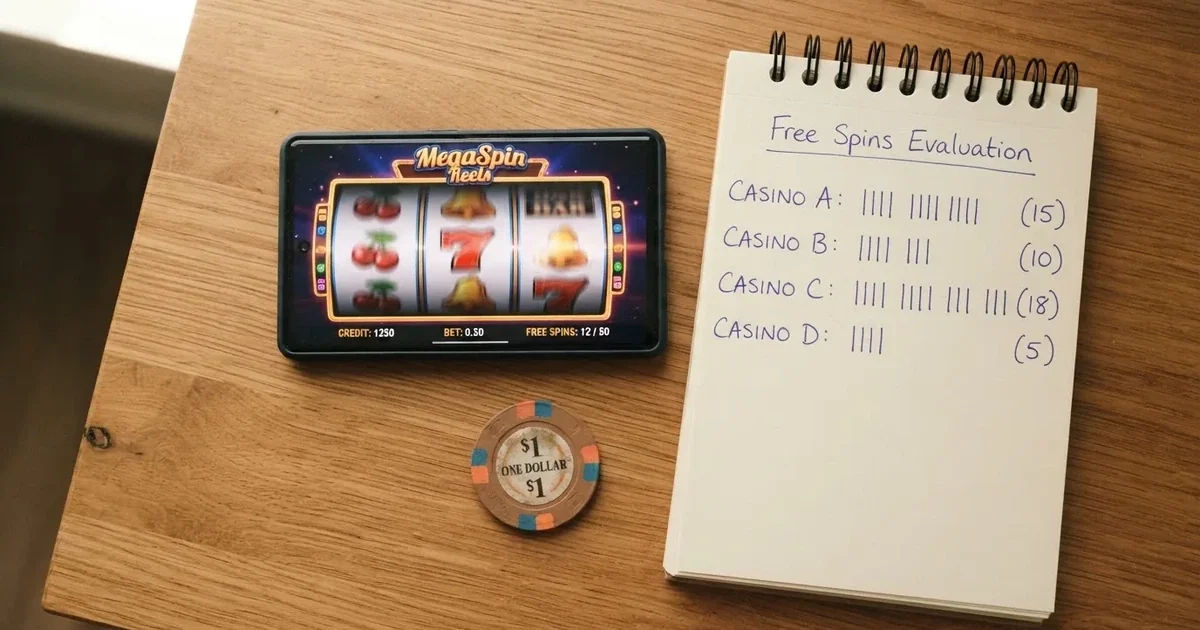
Data current as of 9 October 2026, cross-checked against the Gambling Commission’s public register of gambling businesses.
Table of Contents
- Incentives and their real price
- Payments and how winnings reach a bank
- Bonuses and free spins in the wider market
- Top 10 GB-licensed operators offering forty free spins
- Fundamentals of the no-deposit free-spin offer
- Legality and the licence that makes the offer possible
- Responsible gambling and the tools that cover this offer
- Bonus-cost calculation: the £10x cap in band form
- How to read a forty-spin offer in three steps
- What changes if the offer is on a slot the player dislikes
- What the page does not settle
- Frequently asked questions
Incentives and their real price
The headline number — forty spins — is the part the page sells. The clauses that follow it decide whether the offer is worth claiming. Three rules govern almost every no-deposit free-spin promotion running on a GB-licensed site, and a player who reads nothing else should still read these.

Wagering requirement. Any cash winnings earned on the spins must be re-wagered a stated number of times before withdrawal. Until recently, forty-times wagering on bonus-derived funds was ordinary; the Commission’s December 2025 reform changed that ceiling. A wagering requirement of ten times the bonus value is now the legal maximum for any online casino promotion offered to a GB customer, and any bonus that mixes casino play with another product (a sports bet bundled with casino spins, for instance) is banned outright. The change matters because every number in the small print of a UK-facing offer now sits between zero and ten — the steepest terms that were standard a year ago simply cannot be marketed any longer.
Maximum conversion. A second ceiling sits on the winnings themselves. A promotion that lets the player keep everything won from forty spins would be untenable for the operator, so most convert the bonus balance into withdrawable cash only up to a stated cap — a £10 ceiling is the most common, though some sites run higher. Anything above the cap is forfeit on withdrawal. The cap is the figure that decides the realistic value of a “40 free spins no deposit” headline: forty spins on a low-volatility title at ten pence each, against a £10 conversion cap, can produce £10 of withdrawable cash at most, even if the reels land well.
Expiry. Forty spins do not sit in the account indefinitely. A promotion typically expires seven days from credit, sometimes as little as twenty-four hours, and any unplayed spins vanish when the clock runs out. A player who registers, walks away for a weekend, and returns on Monday can find the offer already closed.
The £10x cap in practice
The December 2025 cap of ten times wagering was the structural change that reshaped this corner of the market. Before it, a £5 bonus carry-over from a 40-spin win could require £200 of play before withdrawal; under the new rule, the same £5 requires £50 of play. The reduction is real, and it is the part of the rule the reader can use directly.
The cap interacts with the conversion limit. A player who converts £10 from the spins and then re-wagers it ten times must place £100 of qualifying play before the bonus balance turns withdrawable. Most of that play happens on slots, and slots carry their own stake ceiling — £5 per game cycle for players aged 25 and over, £2 for 18-to-24-year-olds. So the realistic sequence is: forty spins at the operator’s chosen denomination, then enough subsequent slot play to clear ten times the converted balance, with every stake capped by age.
Payments and how winnings reach a bank
The free spins themselves are credited on registration; the winnings, once converted, need to leave the site. The payment shelf here is not about depositing — no deposit is required for this offer — but about withdrawing. Three things govern how quickly that happens.
Identity checks before the first payout. Every GB-licensed casino must verify the player’s name, address and date of birth before processing the first withdrawal, under the Commission’s customer due-diligence rules that have been in force since May 2019. A no-deposit offer does not exempt a brand from this requirement: the moment a player asks to cash out, the operator will ask for a photo of a passport or driving licence and a proof of address. The check is the slowest step in most withdrawals, and on a brand new account it can take two to three working days to clear.
Credit cards are out. From 14 April 2020, no UK-licensed operator may accept a credit card for any gambling deposit, including a credit card funded through an e-wallet. The rule extends to the deposit side of any future play on the account — even if the original offer was free, any subsequent top-up must come from a debit card or a bank transfer.
Payment options that move money quickly. Withdrawals on GB-licensed brands typically route through the same channel the player used to deposit, where one exists. For a no-deposit offer that is academic — there is no deposit to mirror — so the player chooses the withdrawal method. Bank transfers through the Faster Payments Service, which has operated since 2008 and runs around the clock, usually arrive within minutes for sums up to a million pounds per transaction, though individual banks set their own lower ceilings. Debit cards and e-wallets clear on similar timeframes once the identity check is satisfied.
What “instant withdrawal” really means on a no-deposit win
The phrase is doing more work than it should. The fastest legitimate UK withdrawal still waits on the Commission’s identity-verification step, which is mandatory and cannot be skipped. Operators that advertise “instant payouts” are measuring from the moment the withdrawal is approved internally to the moment the funds land in the player’s bank — and not counting the days the verification team takes to clear a new account. A first withdrawal from a no-deposit offer is therefore rarely instant in any practical sense; twenty-four to seventy-two hours is a realistic expectation, with Faster Payments doing the last mile once the casino has released the funds.
Bonuses and free spins in the wider market
The forty-spin offer is one promotion among many. The wider bonus shelf on a GB-licensed site carries deposit match offers, cashback, prize draws and loyalty rewards, all governed by the same £10x wagering cap and the same conversion rules. Two patterns are worth noticing.
Bonuses have shrunk. The Commission’s December 2025 package — the £10x wagering ceiling, the ban on mixed-product bonuses, tighter rules on how terms are presented — has compressed the headline figures operators can advertise. A “200% deposit match” was once routine; it is now harder to construct under a 10x cap, because the larger the headline bonus, the larger the qualifying-play requirement. Sites have responded with smaller, cleaner offers rather than larger, more restrictive ones.
Spins have replaced cash. Where a deposit match was the headline offer two years ago, a free-spin bundle attached to a smaller deposit is now more common. Spins are easier to govern under the £10x cap because the bonus value is the converted win, not a cash credit — and a £10 cap on a 40-spin win at ten pence per spin is a tidy, predictable ceiling.
What the offer is worth without a deposit
A back-of-the-envelope calculation: forty spins at ten pence each, on a slot returning 96% over the long run, returns roughly £3.84 in bonus funds before wagering. After the £10x cap is applied, that balance must be re-wagered until it reaches £38 in qualifying play. Whether £3.84 of converted cash is worth £38 of slot play is a question only the player can answer — and the answer depends on whether they intended to play anyway.
Top 10 GB-licensed operators offering forty free spins
The list below ranks ten operators that appear on the Gambling Commission’s public register as holders of an active remote casino operating licence. Several of these brands share a parent licence, and the table records the licence-holder company, the licence number and the domain status as the register shows them on 18 September 2026. The list is a comparison of who is licensed, not who is best — every brand on it has cleared the same regulatory threshold, and the differences between them are about scale, parent company and product focus rather than legal standing.
| Brand | Licence holder | GB remote casino licence | Domain status on the register | 40 free spins support |
|---|---|---|---|---|
| 32Red | Platinum Gaming Limited | 045322-R-324275-019 | Active | No confirmed listing |
| Midnite | Dribble Media Limited | 042647-R-321653-022 | Active | No confirmed listing |
| Sky Vegas | Bonne Terre Gaming Limited | 065519-R-339675-002 | Active | No confirmed listing |
| Jackpotjoy | Gamesys Operations Limited | 038905-R-319430-022 | Active | No confirmed listing |
| BetVictor | BV Gaming Limited | 039576-R-319370-028 | Active | No confirmed listing |
| Casumo | Recro Limited | 061549-R-336718-002 | Active | No confirmed listing |
| Coral | LC International Limited | 054743-R-330863-014 | Active | No confirmed listing |
| Unibet | Platinum Gaming Limited | 045322-R-324275-019 | Active | No confirmed listing |
| Paddy Power | PPB Games Limited | 039411-R-319335-022 | Active | No confirmed listing |
| bet365 | Hillside (UK Gaming) ENC | 055149-R-331499-004 | Active | No confirmed listing |
The empty cells in the right-hand column are not an oversight. The Commission’s public register records who is licensed and what domains they operate; it does not record which promotions each brand is running this week. A “40 free spins no deposit” headline is set by the operator’s marketing team, refreshed on a continuous cycle, and verified only at the moment a player clicks through. The table deliberately leaves that column blank rather than carrying a stale claim across the comparison.
What the table actually shows
Three patterns stand out once the licence numbers line up. The first is shared licences: 32Red and Unibet are both listed against Platinum Gaming Limited’s account 45322, which is the same legal entity holding the same remote casino licence. They are two brands under one roof, not two independent operators. Coral sits in a similar cluster as part of LC International’s portfolio. The Commission’s register records the licence-holder, not the consumer-facing brand, and the consumer-facing brand is what the player signs up to — but the entity that answers to the regulator, and the entity against which a dispute can be raised, is the licence-holder.
The second pattern is the licence number itself. A remote casino operating licence has the form (account)-R-(number)-(suffix), where the leading six digits repeat the licence-holder’s account number and the R marks the licence as remote rather than retail. The suffix tracks the number of licence variations the operator has been issued — 019, 022, 028 — and is the cheapest way to confirm that the licence is current rather than superseded. A licence number ending in -001 was the first variation; -019 is the nineteenth. Both are active, but the suffix on its own tells the player nothing about the licence’s standing — the register’s status field does.
The third is the white-label question. A white-label site trades under another company’s licence; the register marks it with a distinct status, and the 361 white-label entries on the register on 18 September 2026 represent brands that have not held their own licence but run on someone else’s. None of the ten brands above sits in that category — each is listed against its own account — but the wider register is fuller of white-labels than of stand-alone licences, and a player who chooses a less familiar brand should check the status field before signing up.
Fundamentals of the no-deposit free-spin offer
A free-spin promotion credits a set number of spins on a named slot — or a short list of named slots — to a new account, without requiring a deposit. The offer sits at the entry point of a casino’s marketing funnel, which is why every operator runs one and why none of them frames it as the actual product. The product is the deposit that comes afterwards. Three fundamentals shape what the player should expect.
The slot matters as much as the spin count. Forty spins on a high-volatility title and forty spins on a low-volatility title are not the same offer. A high-volatility slot pays less often and in larger amounts; a low-volatility slot pays more often in smaller amounts. For a £10 conversion cap, low-volatility play is statistically the better path to the cap, because more spins return something and the bonus balance accumulates steadily rather than sitting at zero for long stretches.
The denomination is set by the operator. A “40 free spins” offer at one penny per spin has a theoretical ceiling of £3.84 in bonus funds at 96% RTP, while the same headline at twenty pence per spin has a ceiling closer to £7.68. The denomination is rarely on the headline; it lives in the terms, and the player who does not read the terms does not know what they are actually being offered.
Wagering requirements vary by site. Under the £10x cap, the maximum a player must re-wager the converted bonus is ten times its value — but many offers run below the cap, and the difference between 10x and 35x is the difference between clearing a bonus in a single session and never clearing it at all.
The arithmetic the small print hides
The calculation that matters is not the headline but the chain beneath it. Suppose a player converts £10 of bonus funds from the forty spins, and the site’s wagering requirement is 10x. They must place £100 of qualifying play to release the £10 as withdrawable cash. At the £5-per-spin ceiling that applies to players aged 25 and over, that is twenty full-bet spins; at a more realistic ten pence per spin, it is a thousand spins; at £2 per spin (the 18-to-24 ceiling), fifty spins at the maximum stake. The £100 of play is the same regardless of denomination, but the time it takes varies enormously, and so does the house edge the player pays across those thousand spins.
At a 96% RTP, £100 of qualifying play loses £4 on average before the £10 bonus is released. The net expectation is a £6 gain on a bonus that started as forty marketing-led spins — but only if the player converts the full £10 cap, plays through the wagering requirement exactly once, and stops. Any further play on the account after the bonus clears is paid at the slot’s normal rate, with no bonus to offset the house edge.
Legality and the licence that makes the offer possible
The legal shelf is the part of the offer that does not vary by operator. Every brand on the comparison table above is licensed by the Gambling Commission under the Gambling Act 2005, which governs gambling in Great Britain — England, Scotland and Wales — and not in Northern Ireland. Since the Gambling (Licensing and Advertising) Act 2014 took effect, any operator taking customers in Great Britain must hold a Commission licence regardless of where it is based; a Curaçao, Maltese or Gibraltar licence is not a substitute for the GB one. The Commission’s public register is the test of who is licensed and who is not.
Three rules govern the offer itself. Minimum age is eighteen, with photo-ID verified before the first deposit or any play. Online slots carry a maximum stake per game cycle — £5 for players aged 25 and over since 9 April 2025, £2 for 18-to-24-year-olds since 21 May 2025. The £10x wagering cap and the ban on mixed-product bonuses took effect on 19 December 2025, and have reshaped what “40 free spins no deposit” can mean in the small print. Auto-play is banned since 31 October 2021; a slot spin may not complete faster than 2.5 seconds; and losses disguised as wins — a slot that celebrates a return smaller than the stake — are prohibited.
Players pay no tax on gambling winnings in the UK. Operators pay Remote Gaming Duty, raised from 21% to 40% from 1 April 2026.
What an unlicensed site costs the player
The Commission’s powers end at the British border. An offshore brand running on a Curaçao or Anjouan licence may advertise to UK players but does so illegally; the Commission issues cease-and-desist notices, refers the site to payment processors and hosting providers, and works with search engines on delisting, but it does not have statutory power to block access at the ISP level. No penalty is aimed at the player. What the player loses on an unlicensed site is protection: no GAMSTOP coverage, no approved alternative dispute resolution, no complaints route through the Commission. The forty free-spin offer on such a site is governed by whatever the operator decides — and the £10x cap, the age-verification rules and the identity checks that make a UK offer predictable simply do not apply.
The register is the test. A player who does not see their brand listed on the Commission’s public register, with an active remote casino licence and an active domain entry, is taking the operator’s word for it. The register is searchable, downloadable as a CSV or Excel file, and is updated as licences change status.
Responsible gambling and the tools that cover this offer
A “40 free spins no deposit” offer is still gambling, and the same safer-gambling tools that govern a £500 deposit apply to a £0 deposit. Three layers of protection matter here.
GAMSTOP is mandatory. Since 31 March 2020, every GB-licensed online operator has been required to participate in GAMSTOP, the national online self-exclusion scheme. A player who has registered with GAMSTOP for six months, one year or five years cannot claim a forty-spin offer at any participating site — the brand is required to check the GAMSTOP database before allowing the player to open an account, deposit or play. A self-exclusion period cannot be cancelled early.
Financial vulnerability checks. From 28 February 2025, GB-licensed operators run a financial vulnerability check at £150 in net deposits over a rolling thirty-day period. The check uses publicly available data only at present; wider financial risk assessments have been announced but are not yet in force. The threshold matters because it sets the level at which the operator is required to look beyond the player’s account history — and a player who crosses it on a small-deposit pattern will be subject to the same scrutiny as a player who crosses it on a large one.
Deposit limits and reality checks. Operators must prompt a customer to set a financial limit before the first deposit, a rule in force since 31 October 2025. There is no state-set deposit ceiling — the player chooses their own limit, and the operator must honour it. Reality-check pop-ups at set intervals are mandatory on every slot session; time-out tools, from twenty-four hours to six weeks, are available on every account.
What self-excluded players should know
GAMSTOP covers the forty-spin offer the same way it covers a £500 deposit. A player in an active exclusion period cannot sign up to a new GB-licensed site, and the database check happens before the bonus is credited. Bypassing GAMSTOP by using a different name, address or date of birth is a breach of the self-exclusion agreement and may itself be a regulatory issue. The National Gambling Helpline (GamCare) and GambleAware are the two routes into support for anyone considering exclusion or concerned about their play.
Bonus-cost calculation: the £10x cap in band form
The calculation this page commits to is the wagering-turnover band that a £10x cap imposes on a typical no-deposit free-spin conversion. The inputs are the bonus value, the 10x multiplier that has been the legal ceiling since 19 December 2025, and the range of converted balances a forty-spin offer can plausibly produce.
A converted balance of £5 — the floor of a typical small-denomination forty-spin win — requires £50 of qualifying turnover to clear at 10x. A converted balance of £10 — the typical conversion cap — requires £100. The £50-to-£100 range is the wagering turnover the player must produce before any of the bonus becomes withdrawable, and the spread comes from the spread in what forty spins can realistically return. At the £5-per-spin stake ceiling for players aged 25 and over, the lower end of the band takes ten qualifying spins; at a more typical ten pence per spin, the lower end takes five hundred. At the £2-per-spin ceiling for 18-to-24-year-olds, twenty-five qualifying spins clears the lower bound of the band.
The conclusion is a band, not a figure. The £10x cap produces a £50-to-£100 turnover obligation, with the actual position inside that band set by how much the forty spins convert and at what denomination the wagering requirement is played through. The cap is the rule; the band is what it looks like for any given offer; the spread within the band is the player’s choice.
Reading the band against a real offer
The turnover band is the same shape whatever the offer — but the time it takes to clear it is not. A £100 turnover at £5 per spin is twenty minutes of play; at ten pence per spin, it is closer to two hours; at one penny per spin, twenty hours. The denomination the operator sets in the small print decides how long the bonus takes to clear, and the £10x cap decides how much must be cleared before the bonus pays out. The two rules together — a fixed turnover target and a stake ceiling — produce a fairly narrow range of total time, from under an hour to most of a day, and that is the realistic cost of converting a “40 free spins no deposit” offer into cash in the bank.
The calculation is an estimate, not a guarantee. The £50-to-£100 band is what a player should expect to wager on average to release the bonus, assuming the converted balance sits between £5 and £10 and the wagering requirement is at the £10x legal maximum. The house edge on the slot eats into the bonus along the way; the band is the requirement, and the realised loss is whatever the slot’s RTP makes of it.
How to read a forty-spin offer in three steps
A player who reads the small print before clicking through saves themselves the most common losses. Three checks catch almost everything that matters.
Step one is the licence. The brand should be on the Commission’s register with an active remote casino licence and an active domain entry. If the brand is not on the register, or the domain status is anything other than Active, the offer is not covered by the £10x cap, the safer-gambling tools, or the complaints procedure. The register takes five minutes to check, and it is the single highest-value check a player can run.
Step two is the wagering requirement. Under the £10x cap, a figure above ten is illegal; a figure at ten is the legal maximum; a figure below ten is the best the offer will get. The wagering requirement should appear in the bonus terms with the qualifying games listed, and the player should know what they will be playing before they accept.
Step three is the conversion cap. The maximum-win ceiling is the figure that decides whether the offer is worth claiming at all. A £10 cap on forty ten-penny spins is the realistic ceiling of the offer; a £50 cap on forty twenty-penny spins is a richer offer, but rarer. The cap is the single number that converts “free” into a quantifiable figure.
What changes if the offer is on a slot the player dislikes
The forty spins are tied to a specific slot or a short list. A player who dislikes the named slot will find the offer hard to enjoy, and the wagering requirement that follows compounds the problem — the wagering is also played on slots, often the same named title. The choice between accepting and declining an offer on an unfavoured slot comes down to whether the converted bonus, with its conversion cap and wagering requirement, is worth playing through on a game the player does not enjoy.
There is no rule requiring the operator to make the bonus playable on a wider slot list. The terms are the terms, and the player who reads them before claiming knows what they are signing up to.
What the page does not settle
Two questions sit outside what the Commission’s register can answer, and the page leaves them open rather than guessing.
The first is the current promotion. The Commission’s register does not record what each licensed brand is marketing this week; the register records who is licensed, not what they are offering. A player looking for a “40 free spins no deposit” offer this week should check the operator’s own promotion page rather than rely on a comparison snapshot. The ten brands above are licensed to offer such a promotion; whether they are offering one today, and on what terms, is a question the operator’s site answers.
The second is the dispute route. The Commission licenses operators and resolves complaints against them through approved alternative dispute resolution providers, but the route from a player’s first complaint to a final resolution runs through the operator’s internal process first. A player who is unhappy with how a forty-spin offer has been applied must raise it with the operator, allow the operator’s complaint team to respond, and only then escalate to the ADR provider if the response is unsatisfactory. The Commission does not adjudicate individual disputes; it oversees the framework.
Frequently asked questions
What does 40 free spins with no deposit actually mean?
It is a promotion that credits forty spins on a named slot to a new account without requiring the player to deposit first. Any winnings from those spins are paid as bonus funds, not as withdrawable cash, and they pass through a wagering requirement and a conversion cap before they can be withdrawn. The offer is a marketing entry point, not a free lunch; the product is the play that comes afterwards.
Are there wagering requirements on winnings from 40 free spins?
Yes. Under the Commission’s December 2025 reform, the maximum wagering requirement on any GB-licensed casino bonus is ten times the bonus value. Many offers sit below the cap. The wagering requirement applies to the converted bonus balance — the cash value of the free-spin winnings after the conversion cap is applied — and must be completed before the bonus balance turns withdrawable.
Is there a maximum win cap on 40 no-deposit free spins?
Almost always. A £10 conversion cap is the most common, though some brands run higher. Anything above the cap is forfeit on withdrawal. The cap is the single figure that converts “40 free spins no deposit” from an open-ended prize into a quantified one, and it is set by the operator in the bonus terms.
Does GAMSTOP self-exclusion cover a 40 free spins offer?
Yes. GAMSTOP covers every form of play at every GB-licensed online operator, including a no-deposit free-spin offer. A player in an active self-exclusion period — six months, one year or five years — cannot claim the bonus at any participating site; the brand must check the GAMSTOP database before allowing the player to open an account or play. The exclusion period cannot be cancelled early.
Must a casino be licensed by the Gambling Commission to offer 40 free spins with no deposit to UK players?
Yes. Under the Gambling Act 2005 and the Gambling (Licensing and Advertising) Act 2014, any operator taking customers in Great Britain needs a Commission licence regardless of where it is based. An offshore licence is not a substitute. The Commission’s public register is the test of who is licensed and who is not, and an unlicensed brand has no obligation to honour the £10x cap, the safer-gambling tools or the ADR complaints route.
How long do 40 no-deposit free spins stay valid once credited?
Typically seven days from credit, though some offers run as short as twenty-four hours. Any unplayed spins expire when the clock runs out, and the converted balance they would have produced is forfeit. The expiry is set by the operator in the bonus terms and is one of the three figures a player should check before claiming, alongside the wagering requirement and the conversion cap.