
Best online casino game shows UK 2026 — the formats, the licences, and what the wagering cap actually does
 Available in GB
Live casino game shows are the wheel-and-presenter formats streamed from a studio, with a real host spinning money wheels, drawing cards, or running a multiplier curve while players bet behind the screen. They look different from the felt-and-cardroom setting of conventional table games, and the Gambling Commission treats them as a separate product line in its remote technical standards. The interest in the format, measured by search volume and the size of the studios behind it, is large enough that the question is no longer whether a UK player can find one but which licensed site carries the version they want, and what the offer wrapped around that version is actually worth.

This page works through the live game show shelf as it sits on UK-licensed sites in 2026, with the angle that a live game show is a product a player pays to play, and the arithmetic of that payment is what the rest of the article is for. The studios, the licences, the safer-gambling regime, and the operator set that carries these titles on a Gambling Commission account are all covered. So is the £10x wagering cap that took effect on 19 December 2025 — a rule that changed what a casino bonus can demand of a player, and that sits behind almost every headline number on a UK welcome page.
Data current as of 23 September 2026 and checked against the Gambling Commission’s public register of gambling businesses.
Table of Contents
- The format itself — what a live game show is, and how it differs from a table game
- The titles a UK player meets, and what each is for
- The licensed landscape — a side-by-side view of the operators
- The licence regime — what a UK remote casino licence actually obliges
- The 10x wagering cap — what a bonus now costs the player
- Responsible gambling around a live game show
- Payment rails and the credit-card ban
- The operator set, in detail
- What the licence number actually tells a player
- The cost picture in summary
- Frequently asked questions about live casino game shows on UK-licensed sites
The format itself — what a live game show is, and how it differs from a table game
A live casino game show is a real-money betting product broadcast from a studio, with a human presenter, a wheel or card-based mechanic, and a betting grid that behaves more like a quiz show than a blackjack table. The player bets on which segment the wheel lands on, or on a multiplier the host reveals, or on a card drawn from a shoe — and the studio’s job is to make that mechanic feel closer to television than to a felt-and-deck casino floor.
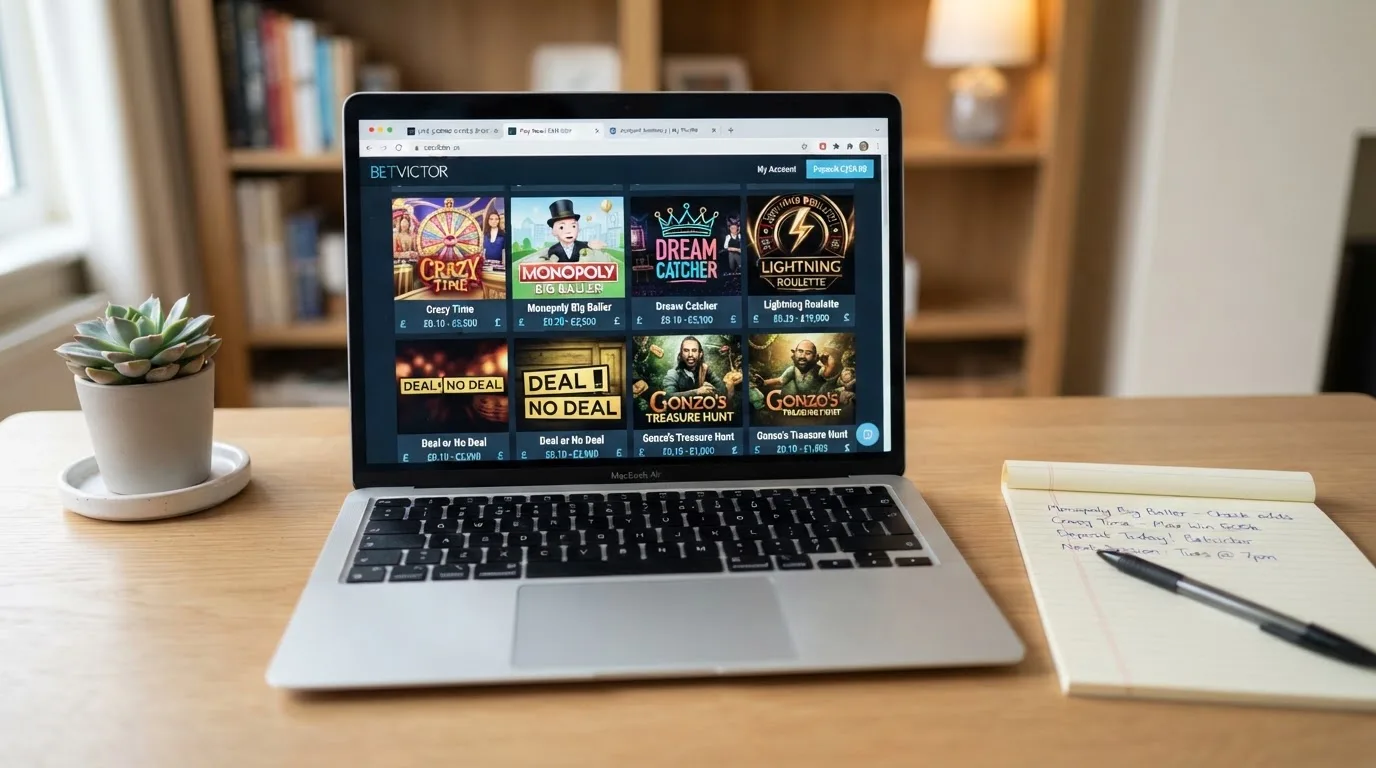
The category is recent. Evolution AB, a live casino studio founded in 2006 and headquartered in Stockholm, launched its Dream Catcher title in 2017 and created the live “Game Shows” category with it. Dream Catcher is played on a vertically mounted wheel with 54 segments — 52 numbered (1, 2, 5, 10, 20 or 40) and two multiplier segments (2x and 7x). The studio expanded the category in 2019 with MONOPOLY Live and Deal or No Deal Live, then launched Crazy Time in 2020 and Funky Time, a 1970s disco-themed live game show, in 2023. The same studio acquired NetEnt and Red Tiger, both slot and game-content studios, in 2020, so the major slot and live-game-show libraries in the UK now sit under one listed Swedish operator.
The split from a conventional table game is the studio production and the betting structure. A blackjack or roulette table is a low-production camera on a green baize with a dealer; the betting grid is two or three boxes; the player’s decision is a stake and a position. A game show has a director, a sound desk, a presenter whose job is to hold the room, and a betting grid that usually runs to dozens of outcomes per round — number and colour on a money wheel, bonus rounds and multiplier segments on Crazy Time, the full Monopoly board on MONOPOLY Live. The category also catches the crash-style titles, such as Aviator, developed by Spribe (founded 2018), released in 2019, and described by its maker as “the first true multiplayer crash game in the regulated igaming space”. In a crash game, a multiplier curve rises from 1.00x until the round randomly crashes, and a player must cash out before the crash to win their stake multiplied by the current value. Spribe has reported more than 42 million active users and around 350,000 bets per minute across more than 5,000 operators worldwide for the title.
So far so descriptive. The cost question sits underneath. A money wheel is a probability table, and a crash curve is a probability table in a different costume — both have a house edge the operator collects on every round, paid out of stakes the player has already committed. The format is new; the arithmetic is not. That is what makes the rest of this page necessary: the studio production is a wrapper on a probability the player pays for, and the licence regime and the bonus terms around it decide how much that wrapper costs.
The titles a UK player meets, and what each is for
The titles a UK player meets on a Gambling Commission-licensed site cluster into three families — money wheels, board- and card-based game shows, and crash-style multipliers. Knowing which family a title sits in is the first cost decision, because the house edge on a money wheel is fixed by its segments, and the house edge on a crash curve is fixed by the random crash point. The studio does not choose either after the fact.

Money wheels: Dream Catcher, Crazy Time, Funky Time, MONOPOLY Live
Money wheels are the spine of the live game show category. The wheel is vertical, the segments are numbered, and the betting grid takes a stake on which number lands. Dream Catcher, the original, pays 1:1 on segment 1, 2:1 on segment 2, 5:1 on 5, 10:1 on 10, 20:1 on 20 and 40:1 on 40, with 2x and 7x multiplier segments that double or septuple the next spin’s payout without themselves being bettable. The 54-segment layout fixes the house edge; the player does not negotiate it.
Crazy Time is the studio’s elaboration on the same wheel. Funky Time re-skins the mechanic into a 1970s disco set. MONOPOLY Live puts a money wheel beside a 3D Monopoly board, with the board paying out a bonus round when its segment lands. All three are produced by Evolution and stream from its studios, with betting limits and presentation varying by operator.
Board- and card-based game shows: Deal or No Deal Live, MONOPOLY Live’s bonus board
Deal or No Deal Live, launched in 2019 alongside MONOPOLY Live, is built on the Endemol Shine format: the presenter opens a sequence of briefcases with monetary values, and the player decides when to take the banker’s offer. The format is closer to a television game show than a money wheel, and the betting grid sits around the bonus round rather than around a wheel spin. The format is one of the few live game show products built on a third-party licensed brand rather than a studio’s original mechanic.
Crash-style multipliers: Aviator
Aviator sits in a different mechanic. The studio (Spribe) shows a multiplier curve climbing from 1.00x, and the player clicks to cash out before the curve crashes. There is no wheel and no presenter in the conventional sense — there is a chat panel and an automatic cash-out option. Aviator’s scale across operators is large — more than 42 million active users and roughly 350,000 bets per minute across more than 5,000 operators worldwide — but the per-round house edge is set by the random crash distribution rather than by a visible wheel.
The licensed landscape — a side-by-side view of the operators
The comparison below covers the ten Gambling Commission-licensed brands reviewed on this page. Every row is a real licence line on the Commission’s public register, and the register was the source for the licence numbers, account IDs and domain statuses. Several of the operators share an account — Virgin Games and Jackpotjoy both sit under Gamesys Operations Limited (account 38905) — so the licence lines read in duplicate by design.
The brands are listed in the order the research sets; this is a description of who holds a remote casino licence on a current account, not a ranking of who to play with.
| Feature | Regulation |
|---|---|
| Max Slot Stake | £5 (£2 for 18-24s) |
| Wagering Cap | 10x bonus amount |
| Autoplay | Banned |
| Reverse Withdrawals | Banned |
The dashes in the right-hand column are not an oversight — they are the honest answer to a question research could not answer. The Commission’s register tells a reader who is licensed and on what terms, but it does not catalogue which live game show titles each brand carries or which studios stream into each lobby. Several of these brands do carry live game shows in their UK product; the register is the wrong place to look for that detail, and it is the only place this page looks. What the table establishes is the licence a player is paying into if they bet on any of these brands, and the operator account that licence sits on.
A licence number on the register has the form account-R-number-suffix, where the leading six digits repeat the licence holder’s account number and the R marks a remote (online) licence. The number is the test of whether the brand a reader is on is the brand the Commission licensed. If the licence number on a site’s footer does not match the register entry, something is wrong.
The licence regime — what a UK remote casino licence actually obliges
The Gambling Commission is the regulator. It is sponsored by the Department for Culture, Media and Sport, and it operates under the Gambling Act 2005 — which covers Great Britain (England, Scotland and Wales), not Northern Ireland. Since the Gambling (Licensing and Advertising) Act 2014 any operator taking customers in Great Britain needs a Commission licence wherever the operator itself is based; a Curaçao, Maltese or Gibraltar licence is not a substitute for a UK one. On 18 September 2026 the Commission’s public register listed 139 businesses holding an active remote casino operating licence, and 1,065 active and 361 white-label website entries — a white-label site trades under another company’s licence, so Virgin Games, for instance, is listed as a white-label domain of account 38905 (Gamesys Operations Limited). A reader can search the register online and download it in full as CSV or Excel files.
The licence carries obligations the operator must meet before it can take a stake. Minimum age is 18, and name, address and date of birth are verified before the first deposit or any play — anonymous play is not possible at a licensed site. The Commission’s Licence Conditions and Codes of Practice (LCCP) and the social responsibility code set out the rest: customer interaction, self-exclusion, advertising standards, and the technical standards that govern how the game itself runs.
The remote technical standards — what changed on 17 January 2025
The Commission’s revised remote gambling and software technical standards took effect on 17 January 2025, extending rules that already applied to online slots — autoplay restrictions, a minimum speed of play, a ban on losses disguised as wins — to other online gaming products including live game shows. Two consequences sit directly behind the wheel on the screen.
First, gambling systems including live game show products must not use winning-style auditory or visual effects to celebrate a return that is less than or equal to the player’s total stake. A wheel spin that returns less than the stake placed cannot be celebrated with the sound and visual cues the studio used to use. The point is to remove the “win” cue when the round has in fact been a net loss.
Second, online gaming products, including game shows, must display information on a player’s net spend and net time in play. A player sitting in front of Crazy Time for an hour must be able to see, on the same screen, what they have staked and what they have had back. That is the technical implementation of the same idea: a player who can see the net figure is harder to mislead by the production around them.
Stake limits, deposit prompts and the £10x wagering cap
The stake regime the Commission has built over the past two years is the one most readers will meet first. Online slots carry a maximum stake per game cycle — £5 for players aged 25 and over (from 9 April 2025) and £2 for 18-24 year olds (from 21 May 2025). The lower limit for under-25s follows government reasoning that this age group has the highest average problem gambling score of any age group, combined with lower disposable income and ongoing neurological development. Live game shows are not slots — a Crazy Time spin is not a slot spin under the same rule — but the technical standards above still apply to them.
The Commission does not set a state-set deposit or loss ceiling. What it does require is that operators prompt a customer to set a financial limit before the first deposit — in force from 31 October 2025. A player opening an account must set one before they can fund it. There is no Commission-set number on what that limit should be; the operator must prompt, and the player chooses.
The wagering regime is the one that has done the most to flatten the welcome-page maths. Since 19 December 2025 wagering requirements are capped at 10x and mixed-product bonuses (a bet on sport, get casino spins) are banned. The 10x cap is the rule behind almost every headline number on a UK welcome page from late 2026 onwards, and it is the rule that makes the next section of this page worth writing.
The 10x wagering cap — what a bonus now costs the player
A wagering requirement is the multiple of a bonus the player must stake before the bonus funds convert to withdrawable cash. The 10x cap, in force from 19 December 2025, is the upper limit: no UK-licensed operator may require a player to wager more than ten times the bonus amount before withdrawing. Before the cap, 35x and 50x were common; the cap pulled that ceiling down.
A £100 bonus at a 10x wagering requirement means the player must place £1,000 of qualifying stakes before the bonus converts. At an average slot stake of £1 a spin, that is 1,000 spins; at the Commission’s minimum spin interval of 2.5 seconds, that is 2,500 seconds, or roughly 42 minutes of continuous play. If the same player drops to a £0.20 spin — more typical for a long session on a money wheel with a low minimum — the spin count rises to 5,000 and the wall-clock time at a 2.5-second interval to about 3.5 hours. The single figure that fixes the cost is the wagering multiple; the assumptions that decide the rest are stake size and spin speed.
That figure is a band, not a single number, and the band has a condition: assuming the player wagers only the bonus amount, plays at the minimum spin interval the Commission allows, and does not lose the bankroll before clearing. Real sessions deviate from all three, and the wagering requirement is a target the player can fall short of as well as hit.
The same rule cuts the other way on a smaller bonus. A £10 bonus at the same 10x cap requires £100 of qualifying wagers — 100 spins at £1, or roughly four minutes of continuous play. The cap is a ceiling; nothing forces a bonus to clear at the cap. Operators routinely set wagering requirements below 10x, and the player who can find one clears the bonus faster and keeps more of the bankroll.
The point is not that bonuses are now free. The point is that the multiple on which the bonus is sold is now a number the player can read against the cap. A 10x bonus is the most a UK licensee can ask for; anything marketed as “high” is, by definition, at the ceiling. A bonus marketed below that is, by definition, below it. Either way, the player can do the multiplication before they take the offer.
A worked illustration
A £200 welcome bonus with a 10x wagering requirement means £2,000 of qualifying stakes. At £1 a spin, that is 2,000 spins; at 2.5 seconds per spin, that is 5,000 seconds, or about 1 hour 23 minutes of continuous play. At £0.20 a spin, the spin count rises to 10,000 and the wall-clock time to about 6 hours 57 minutes. The slot RTP over those spins is the figure that decides the bonus’s expected cost: if the slot pays back 96% over the long run, the £2,000 wager returns £1,920 on average, and the £80 difference is what the bonus costs the player before any win is counted.
These are session-level estimates, not promises. The 96% is an average over many spins; a player who hits a feature round early can be ahead, and a player who does not can be down long before the wagering requirement is met. The number that the wagering cap fixes is the time and stake the bonus demands, not the outcome.
Responsible gambling around a live game show
The safer-gambling regime around live game shows in the UK is built into the licence. GAMSTOP, the national online self-exclusion scheme, is a mandatory condition of every online licence since 31 March 2020 — a player self-excludes for six months, one year or five years, and the exclusion cannot be cancelled early. Operators must check every new account against GAMSTOP before the first deposit. The Commission also requires that operators run financial vulnerability checks at £150 net deposits in a rolling 30-day period (from 28 February 2025), using public data only; wider financial risk assessments are announced but not yet in force.
The technical protections in the section above extend to live game shows: no autoplay on slots (autoplay was permanently banned on slots after research indicated the feature caused players to lose track of their gambling activity); a slot spin may not be faster than 2.5 seconds; a ban on reverse withdrawals (operators had until 31 October 2021 to fully implement the ban, which had previously let consumers re-gamble funds they had already requested to withdraw); and the same net-spend and net-time display rules that apply to slots.
Help is available outside the operator. The National Gambling Helpline is run by GamCare; GambleAware funds treatment and research across Great Britain; the Commission’s own complaints route is available where an operator has failed to honour the LCCP or the social responsibility code. There is no penalty aimed at the player on an unlicensed site, but what the player loses on such a site is the protection — no GAMSTOP, no Commission complaints route, no approved ADR. The Commission’s disruption work (cease-and-desist notices, search-engine delisting, payment and hosting referrals) has no ISP-blocking power, which is why the safer course is to check the licence before staking.
The interactive side of safer gambling on a live game show is the player’s. The studio does not stop a player re-betting on the same outcome, and the chat panel and the presenter will keep the room going for as long as the player sits in it. The reality check, the net-spend figure, and the GAMSTOP registration are the lines the regime draws around the player; the player has to stay inside them.
Payment rails and the credit-card ban
Since 14 April 2020, credit cards have been banned for gambling in Great Britain, including credit cards routed through e-wallets — a player cannot fund a casino account with a credit card, and cannot route a credit card through PayPal or a similar wallet to get there. Debit cards, bank transfers and a closed list of approved e-wallets are the routes a UK-licensed site can take. The rule closes a line of credit the operator used to extend without the customer’s bank knowing, and it is one of the protections that disappears on an unlicensed site.
Players pay no tax on gambling winnings in the UK. Operators pay Remote Gaming Duty, which is raised from 21% to 40% from 1 April 2026 — model only, and the operator’s own tax position is theirs to confirm with HMRC. The duty raise does not change what the player keeps from a win, but it is one of the inputs into the welcome offer an operator can sustain.
The operator set, in detail
The ten brands below are described in the order research sets and on the fields the register carries. They are not a ranking. Where a brand’s profile cuts against the page’s own subject — a brand where the safer-gambling regime sits front and centre, for instance — the mismatch is named and the brand is shown on its other fields.
| Brand | Licence Holder | Licence Number |
|---|---|---|
| Virgin Games | Gamesys Operations Limited (account 38905) | 038905-R-319430-022 |
| Betfred | Petfre (Gibraltar) Limited (account 39544) | 039544-R-319290-010 |
| Betfair | PPB Games Limited (account 39411) | 039411-R-319335-010 |
| Sky Vegas | Bonne Terre Gaming Limited (account 65519) | 065519-R-339675-002 |
| Gala Bingo | LC International Limited (account 54743) | 054743-R-330863-014 |
| 32Red | Platinum Gaming Limited (account 45322) | 045322-R-324275-019 |
| Casumo | Recro Limited | — |
| Midnite | — | — |
| PokerStars | Stars Interactive | — |
| Jackpotjoy | Gamesys Operations Limited (account 38905) | 038905-R-319430-022 |
Virgin Games
Virgin Games is listed on the Gambling Commission register as a white-label domain of account 38905, Gamesys Operations Limited. That account also holds Jackpotjoy, so the two brands sit on the same licence line and the same account number, with Virgin Games as the white-label entry. The licence is 038905-R-319430-022. A white-label entry is not a lesser licence — it is a different commercial structure, with the brand trading under another’s licence — but the player is paying into Gamesys’s compliance, not into Virgin’s own account.
The interesting feature of this licence line is that two major consumer brands sit under one operator. A player who closes one account and opens the other on the same morning is, in the Commission’s eyes, not moving operators at all. That is a useful frame for the player who cares about the operator behind the brand.
Betfred
Betfred (Betfred.com) is listed on the register as an active domain of account 39544, Petfre (Gibraltar) Limited, which holds the active remote casino operating licence 039544-R-319290-010. The Petfre name is the historic one; the Gibraltar location is the seat of the holding company, not the licence location — the licence is a UK Gambling Commission licence, issued under the Gambling Act 2005, and the Commission’s regime applies in full.
The brand is a UK high-street bookmaker, with a casino product that sits beside the sportsbook. A player used to the betting-shop interface will recognise the layout; a player used to a casino-only site will find a wider product on the same wallet.
Betfair
Betfair (Betfair.com) is listed on the register as an active domain of account 39411, PPB Games Limited, which holds the active remote casino operating licence 039411-R-319335-010. The exchange structure is the brand’s differentiator — a sports-betting exchange where players bet against each other rather than against the house — and the casino product sits beside it.
A live game show on Betfair is a casino product, with the casino’s stake limits and the casino’s bonus terms. The exchange is a separate product, and the GAMSTOP registration covers the whole account.
Sky Vegas
Sky Vegas is listed on the register as an active domain of account 65519, Bonne Terre Gaming Limited, which holds the active remote casino operating licence 065519-R-339675-002. The Bonne Terre name is the operating company; the Sky name is the consumer brand.
Sky Vegas’s live game show presence is part of its casino product, and the studio that streams into it is not visible on the register. The page cannot say which titles Sky Vegas carries without straying outside research; the honest answer is that the register confirms the licence, and the live lobby on the site would confirm the titles.
Gala Bingo
Gala Bingo is listed as an active domain under account 54743, LC International Limited, which holds licence 054743-R-330863-014. The LC International account also holds the Ladbrokes and Coral brands, so Gala Bingo sits on a licence line that runs three of the UK’s largest high-street names. The licence line is one of the more concentrated ones on the register.
A live game show on a bingo-led brand is not the obvious product — the lobby is built around bingo rooms — but the casino tab on the same licence carries the live game show studios. The point to keep in mind is the shared licence: a player account at Gala is, for compliance purposes, an account at LC International.
32Red
32Red is listed on the register under account 45322, Platinum Gaming Limited, which holds licence 045322-R-324275-019. The 32Red brand is one of the older casino-only sites on the UK market, with a product built around slots and live casino rather than around sports.
For a player who wants a casino-first product on a long-standing account, 32Red is the line on the register that fits. The live game show presence is part of the casino product.
Casumo
The Casumo brand is a casino-only product, with a gamified loyalty structure that runs across the casino lobby.
The page’s interest here is the licence line, not the loyalty structure. Recro Limited holds an active remote licence; that is what the player is paying into.
Midnite
Midnite is one of the newer entrants on the UK market, and the licence line is one of the more recently issued on the register.
The newer the account, the more recent the licence conditions it carries. The Commission’s standards have tightened over the past five years, and a newer account reflects that. The point is not that older licences are weaker — they are renewed and updated — but that the conditions in force when the licence was last varied are the conditions that apply.
PokerStars
The Stars Interactive account is the international poker operator’s UK arm, with poker as the flagship product and a casino product sitting beside it.
The casino tab on PokerStars carries the live game show studios; the poker client is the product most players arrive for. The shared wallet means a poker player who wanders into a Crazy Time round is paying into the same licence.
Jackpotjoy
Jackpotjoy is the bingo-led brand of the Gamesys account; Virgin Games is the casino-led brand; the player who sits at either is sitting on the same licence line.
The 10 brands above are the full operator set the page reviews. The licence lines, the account numbers and the domain statuses are confirmed against the register; the live game show presence on each is not, because the register does not catalogue that. A reader who wants to know what a brand’s live lobby carries must look at the lobby itself.
What the licence number actually tells a player
The licence number on a site’s footer is the test of whether the brand is the brand the Commission licensed. A reader who wants to check a site can take the licence number from the footer, paste it into the Commission’s public register, and confirm that the account, the licence holder, and the domain all line up. The register’s search returns an entry with the licence number, the holder’s name, the trading names, and the status of the licence. If the entry does not exist or the licence holder is not the operator the site claims to be, the player is not on the brand they think they are on.
That check takes about a minute and is the single most useful thing a UK player can do before they deposit. It is also the test that survives the marketing: a brand can change its welcome offer, change its product line, change its studio list, but it cannot change its licence number without the Commission’s consent. The number is the constant.
The cost picture in summary
A live casino game show on a UK-licensed site in 2026 is a real-money betting product with three layers of cost. The first is the stake: the player pays the bet, and the wheel, the curve or the card draw takes the house edge on every round. The second is the wagering requirement on the bonus, capped at 10x the bonus amount since 19 December 2025 — a ceiling that pulls the worst offers into line and the best offers further down. The third is the player’s time: a £200 bonus at the cap, at a £1 spin and a 2.5-second interval, requires 2,000 spins (about 1 hour 23 minutes) to clear; at a £0.20 spin, it requires 10,000 spins (about 6 hours 57 minutes).
The arithmetic is honest about what it is — an estimate, an average over many spins under stated assumptions, not a guaranteed outcome. The reader who treats it as an estimate can use it to compare offers; the reader who treats it as a promise will be disappointed, because no estimate of an average is the result of any single session. The page has not invented any of the inputs; the wagering cap is from the Commission’s own rules, the spin interval is from the same rules, and the stake figures are the reader’s choice.
The final cost is the one the page cannot quantify: the cost of a session the player walks away from. The Commission’s safer-gambling regime — GAMSTOP, the £150 net-deposit vulnerability check, the net-spend and net-time display, the reality checks — is built to make that cost visible to the player before it gets large. The player who uses those tools uses the licence the way it was designed to be used; the player who doesn’t pays the licence’s omission in the only currency that matters.
Frequently asked questions about live casino game shows on UK-licensed sites
What is a live casino game show, and how is it different from a table game?
A live casino game show is a real-money betting product streamed from a studio with a presenter, a wheel or card-based mechanic, and a betting grid built around studio production rather than a felt-and-deck casino floor. A table game is a low-production camera on a green baize with a dealer and a small betting grid. The categories overlap on the equipment side — both run from studios, both involve a live dealer — and split on the betting grid and the production. The Commission’s remote technical standards treat live game shows as a separate product line for the purposes of autoplay bans, spin-speed rules and net-spend displays, but the licence that covers them is the same remote casino operating licence that covers slots and table games on the same site.
Are live casino game shows streamed from a real studio?
Yes. The studios that produce live game shows are physical sets with cameras, presenters and wheels or card shoes. Evolution, the studio behind Dream Catcher (2017), MONOPOLY Live and Deal or No Deal Live (2019), Crazy Time (2020) and Funky Time (2023), runs its main studios in Europe and streams to licensed operators worldwide. The studio is the product: the live game show category exists because the studio built the wheel and the betting grid, and other studios build wheels and grids in competition. A player on a licensed UK site is watching a live feed from one of those studios; the betting happens on the licensed site, the round happens in the studio.
Do UK-licensed sites publish odds or payout structures for game shows?
A UK-licensed site must publish the return-to-player percentage for each game it offers, including live game shows. The figure is set by the studio and disclosed on the game’s information page — usually accessed via a question-mark or info icon in the lobby. The RTP is an average over many rounds and is not a forecast of any single round. The Commission requires the figure to be published; it does not require a minimum RTP, so the figure varies by title. A player who wants the figure for a specific title should look at the game’s information page on the site they intend to play, and check that the figure is the current one — studios do revise RTPs occasionally, and the regulator requires the live figure to be the one the player sees.
Can a bonus be used to play a live casino game show?
Usually, and the rules vary by site. UK bonuses carry a wagering requirement capped at 10x the bonus amount since 19 December 2025, and the games that contribute to clearing that requirement are set by the operator. Most live game shows contribute 10–20% of the stake to the wagering requirement, against 100% for most online slots — a £10 spin on Crazy Time might count as £1 or £2 against the requirement. The player who wants to clear a bonus on a live game show should check the contribution table on the operator’s terms page before staking. Mixed-product bonuses (a bet on sport, get casino spins) are banned under the same December 2025 rule, so the offer that lands in the casino inbox is the offer the player should read.
Is a live casino game show hosted by a real presenter?
Yes. A live casino game show has a human presenter whose job is to spin the wheel, open the briefcases, draw the cards, and keep the room’s energy up between rounds. The presenter is part of the production — the studio is built around the presenter’s camera — and the presenter’s presence is what marks a live game show apart from an automated game like an online slot or a crash-style title such as Aviator. The presenter does not affect the outcome; the outcome is set by the wheel’s segments, the cards in the shoe, or the random crash point in a crash-style round. The presenter is the show.
Are live casino game shows covered by the same licence as slots on the same site?
Yes. A Gambling Commission remote casino operating licence covers the full remote casino product line — slots, table games, live game shows — on a single licence account. The Commission’s remote technical standards differentiate between slots and other online gaming products on specific points (autoplay, spin-speed, losses-disguised-as-wins), but the licence is one licence. A player on a licensed UK site is paying into one licence regardless of which tab they are in; the licence number on the footer is the test, and the register entry that matches it is the confirmation. Live game shows are part of the same licence line, on the same account, with the same safer-gambling protections.
Created by the ”welcomeoffersuk” editorial team.