
What a UK live casino actually costs the player sitting at the table
 Available in GB
Last updated 23 September 2026 · verified against the Gambling Commission’s public register of remote casino operating licences.

A live dealer table looks simple from the player’s seat: a wheel turns, cards are dealt, a chat window opens. The cost of playing one, though, is set by half a dozen pieces of regulation that have nothing to do with the studio in Riga or the studio in Stockholm streaming the footage. Some of those pieces are about what an operator may charge you. Some are about what it must show you. And some are about what protection disappears the moment you step onto a site that does not hold a British licence at all.
This page works through those pieces against ten brands drawn from the Gambling Commission’s public register, with the live casino angle running through each section rather than sitting on top of it. The headline that follows from that is unglamorous and worth stating up front: on a licensed UK live casino site, the wagering cap, the stake limit and the identity check all bite before a single hand is dealt, and the difference between one operator and the next is mostly how clearly they explain those bites and how quickly the winnings, once they come, reach a bank account.
Table of Contents
- Crypto and anonymity at a UK-licensed live casino
- Payments and payout speed on a live casino
- Bonuses and free spins at a live casino
- Mobile and apps for live casino play
- Specific games, providers and live tables
- Top ten UK-licensed live casinos compared
- Overview of the UK live casino market
- UK legality and the Gambling Commission framework
- Responsible gaming on a UK live casino site
- Frequently asked questions
Crypto and anonymity at a UK-licensed live casino
Anonymity and a UK live casino licence do not coexist. The Gambling Commission has required name, address and date-of-birth verification before the first deposit since 7 May 2019, and that requirement applies regardless of the funding rail a player chooses. A player funding a live dealer table with bitcoin or another cryptocurrency still has to pass the same onboarding as someone paying by debit card. The crypto is settled on the way in, but the identity check sits in front of it.
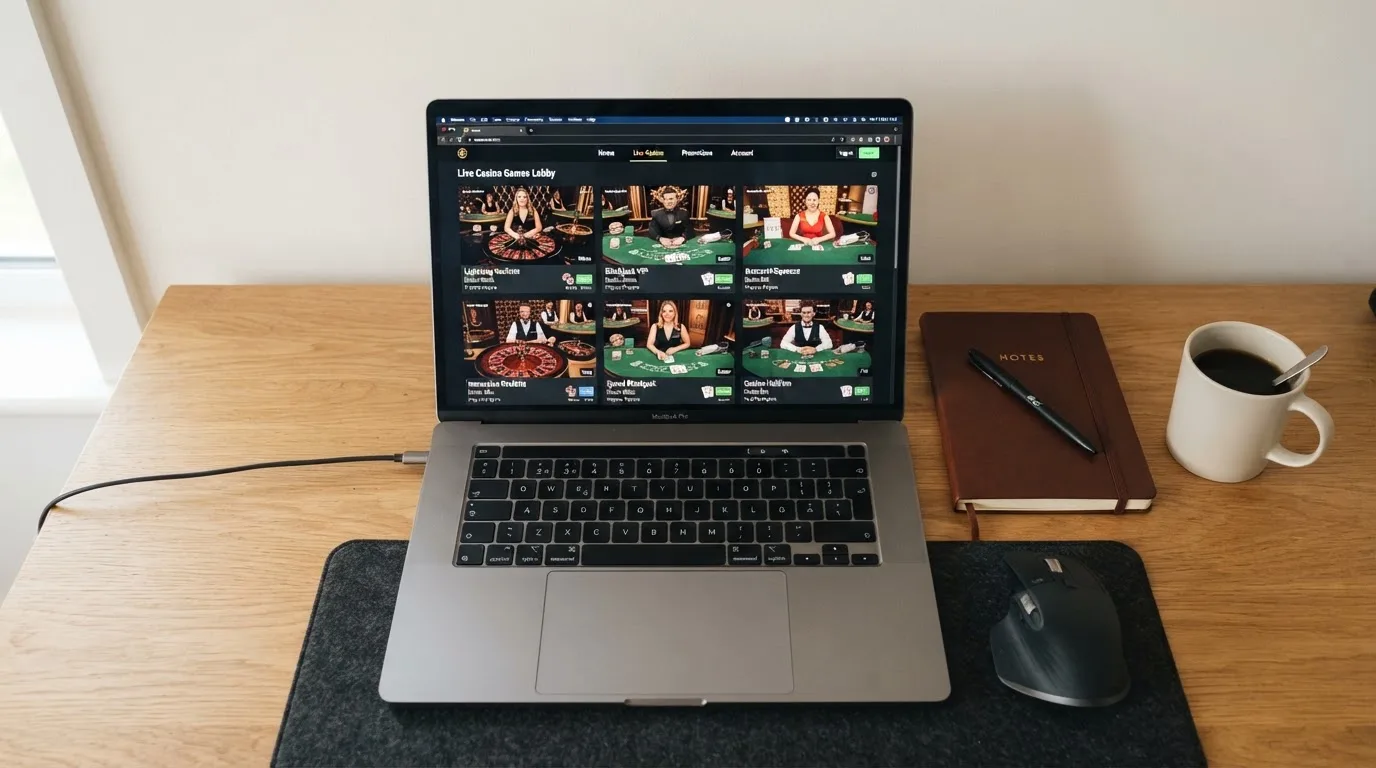
What that means in practice is that the question “can I play live casino with crypto?” is really two questions. The first is whether the licensed site accepts crypto at all, and the answer for the brands in this comparison is generally no: most GB-licensed operators route deposits through debit cards, bank transfer and a small set of e-wallets, and treat cryptocurrency the same way they treat credit cards, which have been banned for gambling since 14 April 2020. The second is whether a crypto-funded play is private, and the answer is no: the operator sees the player’s identity, sees the funding source, and is obliged to keep records the Commission can audit.
iDEAL sits in a similar position. It is a Dutch instant-payment rail, not a privacy rail, and a UK site that accepts it is still a UK site. The rail changes the speed of the deposit, not the visibility of the player.
The honest framing, then, is not “anonymous live casino” but “non-card live casino”. A player who wants to keep their gambling spend off a credit statement has options: bank transfer, certain e-wallets, prepaid vouchers where the operator accepts them. What they do not have, on a licensed site, is the option to skip the part where the operator confirms who they are. The identity check is the price of the licence, and the licence is the price of the protections that go with it.
The offshore alternative, which does accept crypto without identity checks, is covered later in the section on GAMSTOP and on what changes when the licence disappears.
Payments and payout speed on a live casino
The way money moves in and out of a live casino account has changed more in the last eighteen months than the tables themselves have. Three rules now sit over every payment, and each one costs the player something.

The first is the wagering cap. From 19 December 2025, the Gambling Commission set a ceiling of 10x on wagering requirements for casino bonuses, and mixed-product offers (bet on sport, get casino spins) are out. On a £100 bonus, that means £1,000 of qualifying play before a withdrawal becomes possible. The cap is generous relative to where the market was a few years ago — 35x and 50x were common — but it is still a multiplier that a player needs to see before they claim.
The second is the identity check. The Commission has run financial vulnerability checks at £150 of net deposits in any rolling 30-day window since 28 February 2025, using public data only. That check is a credit-bureau look-up, not a deep dive, and it does not block play, but it can prompt a site to ask follow-up questions, set a deposit ceiling, or trigger a reality check. A player hitting £150 in a month for the first time can expect to be asked something.
The third is the payment-method ban. Credit cards were banned for gambling in April 2020, including credit cards routed through e-wallets. A player who tries to fund a live casino session with a credit-funded PayPal balance will find the deposit refused.
What this leaves is a small set of legitimate funding rails: debit card, bank transfer, a handful of e-wallets, and prepaid vouchers where the operator accepts them. Payout speed varies by rail. Debit-card withdrawals on the larger operators typically settle within twenty-four to forty-eight hours once the withdrawal is approved; bank transfer can be slower; e-wallets are usually the fastest. The variation between operators on payout speed is narrower than the marketing suggests — the bigger gap is between licensed and unlicensed, where withdrawals on the latter are routinely delayed, declined or reversed once a player requests one.
A useful comparison is what the player gives up by funding with the fastest rail available. E-wallet deposits are usually instant and withdrawals faster, but a few operators restrict bonuses for e-wallet deposits. Reading the bonus terms before the deposit avoids the situation where a player funds with PayPal, claims a £100 bonus, and discovers at withdrawal that the bonus is void because the deposit rail was excluded.
The wagering cap is the single biggest change to the cost of a bonus in years. On a £100 bonus at 10x, a player needs £1,000 of qualifying turnover. At a £5 max stake on online slots (the higher of the two tiers, for players aged 25 and over), that is two hundred spins at maximum stake. At a £2 max stake (for 18-24-year-olds), it is five hundred. The qualifying game matters too: most operators restrict bonus play to slots, and live dealer tables either contribute nothing or contribute at a reduced percentage. A player who sits down at a £5 live roulette spin and burns through £1,000 of “turnover” has typically not made a single pound of progress on the wagering requirement. The 10x cap protects the player from the worst multiplies, but it does not change which games count.
Bonuses and free spins at a live casino
A live casino bonus is, structurally, a slot bonus with a live dealer label on it. The shape is the same — a deposit match, sometimes with free spins on top — but the game weighting is the part most players miss. Live dealer games typically contribute 0% to 10% of the wagering requirement, where slots contribute 100%. The headline offer is rarely the offer in practice.
Three numbers matter when reading a live casino bonus. The first is the match: 100% up to £100 is the standard shape, with smaller matches at higher caps (£50 up to £500, for example). The second is the wagering requirement, capped at 10x the bonus since 19 December 2025. The third is the game weighting: what percentage of each pound wagered on a live dealer table counts towards clearing the bonus.
A worked example makes the point. Take a £100 bonus at 10x wagering, with slots at 100% weighting and live dealer at 10%. The required turnover on slots is £1,000 — two hundred spins at the £5 max stake. The required turnover on live dealer, if that is what the player wants to play, is £10,000 — and most operators cap the contribution from live games so that a £5 live roulette spin adds only £0.50 to the wagering progress. Two thousand live spins at £5 stake, at five seconds per spin, is just under three hours of play. The bonus pays the same £100 either way, but the path to it through live tables is materially longer.
Free spins attached to a live casino bonus are nearly always slot spins, not live dealer spins. That is not a trick; the free-spin mechanic does not translate to a live dealer format. A “live casino free spins” label usually means free spins on a slot game that the player can use alongside live table play, with the slot play carrying the wagering contribution.
The bonus terms that bite hardest are the ones that appear in the small print. Max cap caps limit how much of a bonus win can be withdrawn — a £100 bonus with a £500 max cap pays out at most £500, even if the bonus funds generated more. Game restrictions exclude high-RTP live tables from play while a bonus is active. Time limits, usually seven to thirty days, force the wagering into a window; if the window closes, the bonus and any winnings from it are forfeit.
The 10x wagering cap is the structural change. It does not make every bonus good — a 10x bonus on a game that contributes 10% is still a 100x effective requirement on that game — but it removes the worst offers from the market. A player comparing two bonuses on the same operator should look at three figures in this order: the wagering multiplier, the game weighting for the game they intend to play, and the time limit. The match percentage and the headline cap come after.
Mobile and apps for live casino play
A live dealer table streams video, which is a heavier lift than a slot reel. The mobile question is whether a phone or tablet can carry that stream without stuttering, and whether the operator has wrapped it in a browser-friendly interface or pushed it through a dedicated app.
The technical answer is that modern phones handle live dealer video without trouble, and the larger studios — Evolution in particular — optimise their streams for mobile connections. The practical answer is more nuanced. Browser play on a mobile browser works, but the interface is smaller, the chat window crowds the betting layout, and the player’s data allowance takes a steady hit during a long session. A dedicated app solves most of these but introduces a different problem: the app is one more piece of software on the phone, and not every operator offers an app on both iOS and Android.
The studios themselves have adapted. Evolution’s mobile-first tables use portrait layouts, with the video stream on top and the betting grid below, and most of the major operators carry these layouts in their mobile lobbies. Pragmatic Play Live and Playtech have done similar work. A player on a five-year-old phone can still play, but the experience degrades faster than on a desktop.
A second question is whether the app adds anything the browser does not. The honest answer is: notifications and biometric login. Push notifications let the operator tell the player about a new table or a promotion, which is a feature for the operator and an irritation for most players. Biometric login — fingerprint or face — speeds up sign-in and reduces the friction of the identity check on subsequent sessions. Beyond those, the app is mostly a wrapper around the same browser experience.
App store availability is the practical limit. The Google Play store and the Apple App Store both restrict real-money gambling apps by region, and in the UK the apps are usually distributed through the operator’s own site after an age and identity check. A player who searches the app store for a UK operator’s app and finds nothing is not being given the runaround — that is how the distribution works in this market.
The one thing mobile play changes about the cost of a live casino session is session length. A phone is in the pocket, the data is metered, and the session is easier to start and harder to stop. Time-outs and reality checks become more important, not less, on mobile.
Specific games, providers and live tables
The live dealer market runs on a handful of studios. Evolution AB, headquartered in Stockholm and listed on Nasdaq Stockholm under the ticker EVO since 2017, is the largest: the company launched its first live dealer games in 2007, acquired NetEnt in 2020 and Big Time Gaming in 2021, and reported revenue of €1.798 billion for 2023 across roughly 19,200 employees. Most UK-licensed live casinos carry Evolution tables, and the studio’s game-show formats — Dream Catcher (2017), Lightning Roulette (2018), Monopoly Live (2019), Crazy Time (2020) and Funky Time (2023) — set the agenda for what a “live casino game” looks like in this market.
Pragmatic Play Live is the second major studio on most UK sites, with a smaller but distinctive catalogue. Playtech Live, OnAir Entertainment and a few smaller suppliers round out the offering. The studio mix varies by operator: some carry only Evolution, some carry three or four.
The games themselves divide into three rough families. The first is the classic table games: live roulette, live blackjack, live baccarat. These are the closest to a land-based casino experience — a human dealer, a physical wheel or shoe, multiple camera angles, betting decisions that take long enough to feel considered. The second is the game-show formats: spinning wheels, bonus rounds, presenters in studio sets, multipliers and side bets. These are louder, faster and structurally closer to a TV game show than a casino floor. The third is the niche formats: craps, sic bo, andar bahar, football studios, and the “crash” games such as Spribe’s Aviator, which released in 2019 and reportedly processes around 350,000 bets per minute across more than 5,000 operators.
Baccarat has its own particular history on a live table. The Punto Banco variant — the form most live casinos offer — banks the game at the casino and deals both hands out by fixed drawing rules, so the player makes no strategic decisions. Chemin de Fer, the French variant, gives players a choice, but is rarely offered live. The history of the game runs from disputed 15th-century Italian origins to a 1940s Havana development of Punto Banco, and that history is part of why the game carries a particular etiquette at the table.
The regulatory frame around live dealer tables is the Gambling Commission’s Remote Technical Standard RTS 17, issued under sections 89 and 97 of the Gambling Act 2005. RTS 17 requires live dealer operations to be fair and independently auditable, with equipment of commercial casino quality, video surveillance covering all gaming areas, and trained croupiers with documented refresher training. The standard is what distinguishes a licensed UK live casino from an offshore stream: the equipment, the surveillance and the training are auditable, and an operator that falls short loses its licence.
RTP on live tables is published game by game. Live roulette sits close to the theoretical 97.3% of the European wheel; live blackjack, played with basic strategy, sits above 99%; live baccarat’s banker bet sits at 98.94% on the standard rules. Game-show formats vary widely and the published RTP is the only number that matters — the volatility profile of a Lightning Roulette round is nothing like a standard live roulette round.
Top ten UK-licensed live casinos compared
The ten brands below are taken from the Gambling Commission’s public register. Each is an active domain against a remote casino operating licence, and each must therefore meet the Commission’s standards on identity checks, payment restrictions, GAMSTOP participation, advertising and the rest. The order is editorial; this is not a ranking of which casino pays out fastest or which bonus is biggest, because the data does not support that comparison and the page is not in the business of inventing it. What follows is a side-by-side of who holds the licence, what domain the Commission has recorded, and what the picture looks like from the outside.
Comparison of licence and operation
| Brand | Licence holder and GB remote casino licence | Domain status on the register | Subject support |
|---|---|---|---|
| MrQ | Tek Fox Ltd · 060629-R-337532-004 | Active | — |
| bet365 | Hillside (UK Gaming) ENC · 055149-R-331499-004 | Active | — |
| PokerStars | Stars Interactive Limited · 039108-R-319334-026 | Active | — |
| Paddy Power | PPB Games Limited · 039411-R-319335-010 | Active | — |
| Betfair | PPB Games Limited · 039411-R-319335-010 | Active | — |
| William Hill | WHG (International) Limited · 039225-R-319373-015 | Active | — |
| BetVictor | BV Gaming Limited · 039576-R-319370-028 | Active | — |
| Sky Vegas | Bonne Terre Gaming Limited · 065519-R-339675-002 | Active | — |
| Virgin Games | Gamesys Operations Limited · 038905-R-319430-022 | White label | — |
| Gala Bingo | LC International Limited · 054743-R-330863-014 | Active | — |
Three things stand out from the table. First, the licence holder is not always the brand name. Paddy Power and Betfair both sit under PPB Games Limited, which means they are not separate operators in the Commission’s eyes and they share the same complaints route, the same ADR provider, and the same senior management. The brand is a marketing wrapper around a single licence. Second, Virgin Games sits as a white-label domain of Gamesys Operations Limited — a white-label site trades under another company’s licence, so a complaint about Virgin Games is a complaint about Gamesys, not about a separate entity. Third, the licence numbers share a shape: the leading six digits repeat the account number and the R marks a remote (online) licence, which is why the table can carry the full string without abbreviation.
The figures that matter for a player comparing these ten are the ones the table deliberately does not show. Payout speed, bonus terms, live table count, app availability and the quality of the mobile stream vary by brand, and none of those variations are settled by a check against the public register. The register tells a player that a brand is licensed; it does not tell a player which brand is faster, friendlier or cheaper.
MrQ
MrQ is the smallest operator in the comparison by brand recognition, and the most recently licensed — the account number, 60629, is higher than any other on the table. The site is listed as an active domain of Tek Fox Ltd, which holds remote casino operating licence 060629-R-337532-004. MrQ’s positioning has historically been on no-wagering bonuses, which the 10x cap from 19 December 2025 has effectively codified into the wider market; a brand that built its offer on zero-wagering free spins is now operating in a market where the worst offers have been brought up toward its own. For a player who reads the small print, the smaller scale of the operator cuts both ways: a smaller games lobby than the major brands, but typically a cleaner presentation of what each bonus actually costs.
bet365
bet365 is the largest operator in the comparison by most measures, and its licence reflects that: Hillside (UK Gaming) ENC holds remote casino operating licence 055149-R-331499-004 under account 55149, with bet365 listed as an active domain. The live casino offering on the site is one of the deepest in the UK market, with multiple Evolution studios and a substantial in-house product. For a player who wants the widest table choice and accepts that “widest” comes with a denser interface, bet365 is the benchmark the other operators are measured against.
PokerStars
PokerStars is best known as a poker site, but its remote casino offering has expanded significantly. Stars Interactive Limited holds remote casino operating licence 039108-R-319334-026 under account 39108, and PokerStars is listed as an active domain. The live casino is built around the major studios and shares a wallet with the poker room, which is useful for a player who splits time between the two. For a player who plays only live dealer, the cross-product wallet is a feature they may not need.
Paddy Power
Paddy Power sits under PPB Games Limited alongside Betfair, which is the same licence account — 39411 — and the same remote casino operating licence 039411-R-319335-010. The two brands are operated as separate marketing entities but are not separate in the Commission’s eyes. Paddy Power’s live casino offering is competitive on breadth and has historically been more promotion-heavy than its sister brand.
Betfair
Betfair shares PPB Games Limited with Paddy Power, and the licensing note in the table applies identically. Where Betfair differs is its heritage as a betting exchange, which shapes the site’s interface and the way its casino product is presented alongside the sportsbook. A player who came to Betfair for the exchange and stayed for the casino will recognise the layout; a player who came directly to the casino may find the sportsbook framing harder to navigate.
William Hill
William Hill is one of the older British bookmaker brands, and WHG (International) Limited holds remote casino operating licence 039225-R-319373-015 under account 39225. The live casino offering is mainstream, drawing on the major studios, and the brand’s high-street heritage is reflected in a more conservative interface than some of the newer entrants. For a player who values the brand recognition over the flash of the newer sites, William Hill is the obvious reference point.
BetVictor
BetVictor sits under BV Gaming Limited, which holds remote casino operating licence 039576-R-319370-028 under account 39576. The brand has historically been associated with horse racing but has built a substantial casino product around it. The live casino offering draws on the standard studio set, and the site’s interface is among the cleaner ones in the comparison.
Sky Vegas
Sky Vegas is the casino brand of Sky, and Bonne Terre Gaming Limited holds remote casino operating licence 065519-R-339675-002 under account 65519. The site carries the standard live casino catalogue and benefits from Sky’s broader media presence. For a player already in the Sky ecosystem — Sky Bet for sports, the TV package for entertainment — the wallet and the single-account experience are the obvious draws.
Virgin Games
Virgin Games is the only white-label site in the comparison: Virgin Games is listed as a white-label domain of Gamesys Operations Limited, which holds remote casino operating licence 038905-R-319430-022 under account 38905. A white-label site trades under another company’s licence, which means a complaint or an ADR referral goes to Gamesys, not to a separate Virgin entity. The live casino offering is mainstream, and the Virgin brand recognition does most of the marketing work.
Gala Bingo
Gala Bingo sits under LC International Limited alongside other brands, but in this comparison it appears alone — the licence account 54743 and the remote casino operating licence 054743-R-330863-014 carry the Gala name. The site’s roots are in bingo rather than casino, and the live casino product sits alongside the bingo rooms rather than dominating them. For a player who plays both, the integrated wallet is the obvious benefit; for a player who plays only live dealer, the bingo framing is decoration.
Overview of the UK live casino market
The UK online casino market runs through the Gambling Commission’s public register, which on 18 September 2026 listed 139 businesses holding an active remote casino operating licence, with the register downloadable as a CSV or Excel file. The register’s domain list records each website against the licence account that runs it — 1,065 active and 361 white-label domain entries on the same date — and a licence number takes the shape account-number-R-number-suffix, where the leading six digits repeat the account number and the “R” marks a remote licence.
What this means for the live casino market is that the same operator can be on the register under several brand names. Paddy Power and Betfair share PPB Games Limited; Virgin Games trades under Gamesys Operations Limited as a white-label site. The brand is the surface, the licence is the substance.
The Commission has required identity verification before the first deposit since 7 May 2019, which means every brand in this comparison runs the same onboarding flow. The minimum age is 18. The stake limits on online slots are £5 per game cycle for players aged 25 and over (from 9 April 2025) and £2 for 18-24-year-olds (from 21 May 2025); these limits do not apply to live dealer tables in the same way they apply to slots, but the identity check and the GAMSTOP participation apply to the whole site.
The numbers that anchor the market are larger than the comparison table suggests. The 1,065 active domains and the 361 white-label entries add up to 1,426 websites on the register; the 139 licence holders sit behind them, some with dozens of domains each. A player who wants to check whether a brand is licensed does not need to know all 139 — they need to know that the public register is the place to check, and that a licence number in the shape above is the format they should see.
UK legality and the Gambling Commission framework
The Gambling Commission is the regulator for gambling in Great Britain — England, Scotland and Wales — sponsored by the Department for Culture, Media and Sport and operating under the Gambling Act 2005. Northern Ireland runs a separate regime. The Gambling (Licensing and Advertising) Act 2014 extended the requirement to hold a Commission licence to any operator taking customers in Great Britain, wherever the operator is based, which means a Curaçao, Maltese or Gibraltar licence is not a substitute.
The framework layers several pieces on top of the licence. The Licence Conditions and Codes of Practice (LCCP) set the operational standards. The social responsibility code sets the player protection requirements. The Remote Technical Standards — RTS 17 for live dealer studios, among others — set the technical requirements for the games themselves.
The player-facing rules that have changed most recently sit on top of this frame. From 9 April 2025, the maximum stake on an online slot game cycle is £5 for players aged 25 and over; from 21 May 2025, it is £2 for 18-24-year-olds. From 28 February 2025, financial vulnerability checks run at £150 of net deposits in a rolling 30-day window. From 31 October 2025, operators must prompt a customer to set a financial limit before the first deposit. From 19 December 2025, wagering requirements are capped at 10x and mixed-product bonuses are banned.
What these changes do, taken together, is compress the cost of a bonus. The 10x cap is the headline; the financial vulnerability check and the mandatory financial-limit prompt change the deposit side. A player claiming a £100 bonus at 10x wagering on slots is now looking at £1,000 of qualifying play rather than the £3,500 or £5,000 a 35x or 50x requirement would have demanded. The compression is uneven — live dealer weighting is still the operator’s choice — but the worst offers have been removed from the market.
The Commission has powers over operators but not over players. A player on an unlicensed site has not committed an offence; the operator has. What the player has lost is the protection: no GAMSTOP, no Commission complaints route, no approved ADR, and no recourse when an unlicensed operator declines a withdrawal. The Commission’s enforcement toolkit against unlicensed sites includes cease-and-desist notices, search-engine delisting, and payment and hosting referrals, but does not include ISP blocking.
Responsible gaming on a UK live casino site
GAMSTOP is the national online self-exclusion scheme, and it is a mandatory condition of every UK online gambling licence since 31 March 2020. A player who registers with GAMSTOP chooses a period — six months, one year or five years — and during that period cannot open a new account or deposit with any GB-licensed operator. The exclusion cannot be cancelled early.
What “not on GAMSTOP” means in the live casino market is, by definition, a site that does not hold a GB licence. The phrase is a marketing label for a brand that wants to reach the players the licensed market excludes — problem gamblers in self-exclusion, players who have hit a deposit limit and want to bypass it, players who want to fund with credit cards or cryptocurrency. The brand is not on GAMSTOP because it is not licensed; the player who plays on it has no Commission complaints route, no ADR, and no UK consumer protection if the operator declines a withdrawal.
The risk to the player is not that the offshore site is dishonest in the everyday sense. Most are not. The risk is that the player who chose to self-exclude has just handed that exclusion back to themselves, and the protection that was supposed to make a hard moment stick has been quietly undone. The Commission’s own disruption work — cease-and-desist notices, payment referrals — does not extend to blocking the site at the ISP level, and the player who wants to play on a non-GAMSTOP site can do so with a search-engine query.
Within the licensed market, the player protection layer is broader than GAMSTOP. The financial vulnerability check at £150 of net deposits is a Commission-level requirement, not a brand-level choice. The mandatory financial-limit prompt before the first deposit is the same. Reality checks during play and time-outs are operator-level features, but the Commission requires them under the social responsibility code. The National Gambling Helpline (GamCare) and GambleAware are the routes to help, and every licensed operator carries their details.
The 18-to-24 age group is the one the UK government has called out specifically. The government has stated that 18-to-24-year-olds have the highest average problem gambling score of any age group, citing this alongside lower disposable income and ongoing neurological development as the reasons for the lower £2 stake limit on online slots. A live dealer table does not carry the same slot-style stake cap, but the identity verification that confirms age applies across the site.
The deeper protections — the ones that bite only when a player is in trouble — are GAMSTOP, the financial vulnerability check, and the Commission’s dispute resolution route through approved ADRs. A player who plays only on a licensed site keeps all three. A player who steps off the licensed market, for whatever reason, loses all three.
Frequently asked questions
What makes a table a “live casino” game rather than a standard digital one?
A live casino game streams real-time footage of a human dealer and physical equipment — a roulette wheel, a shoe of cards, a wheel of fortune — with outcomes captured by cameras and sensors and relayed to players online. A standard digital casino game runs on a random number generator with no live footage and no human dealer. The Gambling Commission’s RTS 17 sets the standards for live dealer equipment, surveillance and croupier training.
Can a live casino table be played through a mobile casino app?
Yes, on most major UK-licensed sites. The major studios — Evolution, Pragmatic Play Live, Playtech — optimise their streams for mobile, and most operators offer either a dedicated app or a mobile browser version of the live casino lobby. App distribution in the UK typically routes through the operator’s own site after age and identity verification, rather than through the Google Play or Apple App stores directly.
What happens to GAMSTOP protection on a live casino site that is not on GAMSTOP?
A site that is not on GAMSTOP is, by definition, not licensed by the Gambling Commission. The player who registers with GAMSTOP and then plays on a non-GAMSTOP site has undone their own self-exclusion: the protection that was supposed to make a hard moment stick has been quietly removed. The player also loses the Commission’s complaints route and any approved ADR, and has no UK consumer protection if the operator declines a withdrawal.
Are live casino tables available to fund with iDEAL or cryptocurrency?
Funding availability depends on the operator, not on the table. iDEAL is a Dutch instant-payment rail accepted by some UK-licensed sites that serve the cross-border market; it does not change the operator’s identity-check obligations. Cryptocurrency is rarely accepted at GB-licensed sites because of the credit-card ban’s wider anti-anonymity posture and the Commission’s KYC requirements, and when it is accepted the player still has to pass the same identity check as a debit-card depositor. Neither rail makes play anonymous on a licensed site.
Do live casino no-deposit bonuses usually carry different wagering to slot bonuses?
A live casino no-deposit bonus carries the same wagering multiplier as a slot bonus in most cases, but the game weighting is different. Most operators count slots at 100% towards the wagering requirement and live dealer games at 0% to 10%, which means the same headline multiplier translates to a much longer effective playthrough on live tables. The 10x wagering cap from 19 December 2025 applies to the bonus regardless of which game the player uses to clear it.
Published by the welcomeoffersuk team.